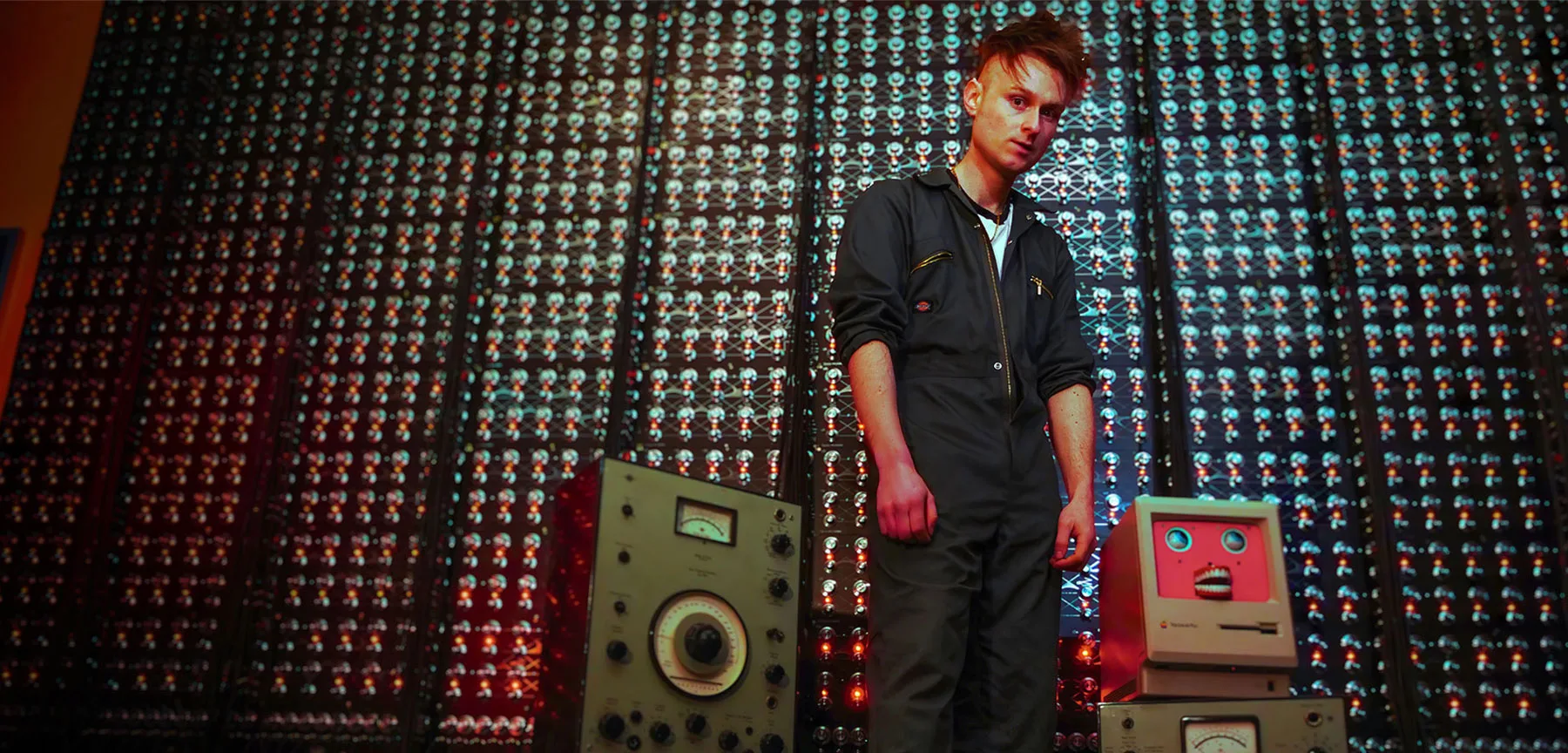
The last time TNT spoke to Sam Battle, love was “a fond tolerance”, his homemade synths had a habit of dying on stage, and he was working seven days a week trying to make a living from building machines nobody needed. Six years later he has a museum, a four-month-old son, a Eurovision appearance behind him, and a fire-breathing organ strapped to a lawnmower. Some things have changed more than others.
Six years ago, Sam Battle told TNT that love was “just a fond tolerance, really”.
It was a very Sam Battle answer. Funny, slightly awkward, and delivered by a man far more comfortable discussing oscillators, unreliable sequencers and flame-throwing organs than feelings. Six years on there is a four-month-old son in the picture, and Sam has written a song called Marvelous.
“Babies are pretty cool,” he says. “It changed my perception on everything.”
He wrote it before his son was born, after he and his wife had been through several failed pregnancies. This time there was a healthy baby on the way, so he did something that, by his standards, counts as alarming. “All of my other songs are pretty negative. So I was like, screw it. I’ll make a disgustingly positive one.”
That tells you more about what has happened to Sam in the last six years than the headline stuff does. And there has been plenty of headline stuff. He has opened a museum. He represented the UK at Eurovision. He has carried on turning old technology into machines that look designed during an argument between Heath Robinson and Kraftwerk. When we speak, he is fitting water jackets to a flame-throwing organ that bolts onto the back of a ride-on lawnmower, keeping it in tune by water-cooling the pipes. So he hasn’t gone soft.
Stop feeding the algorithm
Ask Sam to name his favourite project from the past six years and he doesn’t need long. “Probably the next project I’m doing.” He builds something, finishes it, mostly forgets it, and moves on. “I’m just getting on with it. I’m cracking on.”
That has always been part of the appeal. There isn’t much reverence for the finished object. A machine exists because Sam wanted to find out whether he could make it exist, and once that question is answered another is usually waiting in the sidelines. What has changed is his relationship with the machine behind the machines: YouTube. At some point he realised that dreaming up projects because they might perform well online was making the whole thing worse.
“I kept on feeling like chasing YouTube numbers by making things that were entertain like specifically made for views and stuff just would really not very fun or creative,” he says. “So, I decided to just build the things that I was most excited about really and they’re still, you know, like it’s still helping and working enough.”
Now the test is simpler. Does the idea lodge in his head? Does he catch himself thinking he really wants to make it? If so, one day it flicks like a switch and work begins. It leaves him earning a living from ideas that probably shouldn’t exist, which he knows is a rare position to be in. It is still work, and his description of doing it day after day is characteristically odd. “It’s a bit like you’re always squeezing the melon.”
The melon, at least, has become more reliable. Six years ago, equipment failure was practically part of the show; Sam once told TNT about a sequencer dying at the start of a gig in Germany and having to invent a whole new set on the spot. Now he designs proper printed circuit boards instead of building everything on strip-board, so a unit can take a drop from the top of a pile in the back of a transit van and survive. The same Behringer digital mixer has been in his rig for eight years, since the start, its onboard compressors and gates meaning he can haul the setup onto a stage and be ready in about ten minutes rather than sound-checking for ages.
Not that it has all gone sensible. The touring rig has fallen over more than once. It has ratchet straps now.
Then Eurovision happened
Sam’s route into Eurovision was short on grand strategy. He liked the idea because the contest sits in a cultural space almost nothing else occupies. “It’s completely void of what people would usually perceive as cool.” To Sam, that is a compliment.
He had joked for years that it might be funny to have a go, and a friend kept telling him to do it. Eventually he mentioned it to his manager, who thought the idea equally daft and therefore worth chasing. His management found an email address and pitched the BBC cold. This is Sam, he’s a musician, what do you reckon? The BBC reckoned enough to ask for a song.
One of the songs that came out of that was Marvelous. It wasn’t the entry. That became Eins, Zwei, Drei, written with Thomas Stengaard, Lasse Nymann and Julie Aagaard, and performed by Look Mum No Computer for the UK in Vienna. After months of tests, checks and waiting, going through everything he had ever done alongside another five acts, Sam finally got the question in January: how do you feel about going to Vienna? “I was like oh my god oh my god.”
Then he approached Eurovision the way he approaches building an enormous synthesiser: as another project. “I just gave it my all for a couple of months.”
There was one significant difference. Sam usually controls almost everything, and Eurovision has committees. Suddenly there were producers, designers, choreographers and broadcasters, far more people between an idea and its execution than he was used to. He had to learn “when to throw your toys out the pram in the creative process”. Some things he happily gave up. Hair, styling, choreography, fine, it’s Eurovision.
The pink boiler suit was the hill he was prepared to die on. “I really wanted to wear a pink boiler suit and that was actually something that they really didn’t want.” There were suggestions he might look a bit more fashionable, a bit more couture. Sam was unmoved. “I’m not a fashion couture kind of guy. Where’s a boiler suit? I’m going to Eurovision, so I want a pink one.” The irony is that anyone watching at home could reasonably have assumed a stylist had forced the eccentric synth bloke into a pink boiler suit. In reality the eccentric synth bloke had fought Eurovision for the right to wear it.
Losing Eurovision and enjoying it anyway
The UK finished 25th of 25, with a single point. Sam’s response holds refreshingly little anguish. “I don’t think I knew what to expect, to be honest. I was open to all of the outcomes really.” When the result arrived, his reaction was essentially: fair enough, done that now.
There were unpleasant comments online, because there are always unpleasant comments online. In person, he says, the reaction was overwhelmingly warm. More to the point, Eurovision did something he hadn’t expected. Years of relentless building and content had started to wear on him. “I did start getting a bit tired of constantly building.” Being dragged into a different world, outside his routine and well outside his comfort zone, turned that around. “My life felt reinvigorated actually doing it.” He comes back to it later in the conversation, unprompted: “It was a reinvigoration of my life, strangely enough.”
There was a modern sting in the tail. Eurovision brought him roughly 20,000 new YouTube subscribers, and then about 500 of them worked out that the man in the pink boiler suit was going to carry on posting videos about obscure electronics, and left again. That small reversal was enough to knock his channel’s momentum. “You just got to pay for it.”
The museum of things nobody wanted anymore
Then there is the museum. This Museum Is (Not) Obsolete, which Sam launched in Ramsgate in 2020, is less a shrine to expensive vintage synthesisers than a home for the things that fell between the gaps. “The fancy ones are just all over,” Sam says. You can go to proper places and play those. He is interested in the other stuff: DIY synthesisers from the 1970s and 80s, magazine-project builds like the Digisound, old computers, telephone systems, an ICL One Per Desk. Things that were once ordinary, became worthless, and survived long enough to turn fascinating again.
The Furby organ is there, the mega drone that first made his name, now suffering after years of its motors being driven harder than the toy’s designers can have intended. “It’s not the most hardy of machines,” he says. “It’s the Furby motors. Like you’re overdriving the motors and they’re just like they’re all dying.” There is a church organ, a computer museum, a telephone exchange, and enough unfamiliar switches to keep anyone with poor impulse control busy for an afternoon.
Sam himself tends not to be there during opening hours anymore. He tried it, and the constant conversations wore him out and started eating into everything else he needed to do. Friends run the open hours now, and he slips in afterwards to repair and maintain things.
The computer even AI struggles with
One consequence of preserving obsolete technology is that the machines sometimes outlive the people who know how to fix them. The museum’s old telephone exchange is a case in point. The knowledge needed to maintain it is obscure enough that Sam, partly out of curiosity, tried asking AI for help, expecting rubbish. It got surprisingly close.
It didn’t make him a convert. His problem is that when AI gets a technical question wrong, it does so convincingly. “Nine times out of 10 uh it’s it’s it’s just slightly wrong. It’s not wrong enough for you to notice unless you know basically the answer that you’re trying to get. So it’s not really a kind of oracle really.” When he asked about the exchange’s UAX13 linefinders, it sounded knowledgeable while still missing the actual answer. “It was close.”
For technology built to stand in for human knowledge, being seen off by a telephone exchange has a certain charm.
Then somebody gave him a baby
There is now another limit on Sam’s ability to vanish into a project for fourteen hours. The old routine ran from eight in the morning until ten at night, every day, with barely a break. That has gone. Now it is up at six, finished by five, six days a week, up two hours earlier than he would like just to get the work done. “There’s no time to stop.”
Fatherhood has also started the important educational work early. His son is four months old, and Sam is already trying to explain wheels to him. “I feel wheels is a very direct thing that could get them into engineering and thinking about how things work.” Furby motor replacement presumably comes later in the syllabus.
So what next?
This is where questions get difficult. What comes after the current project? “I haven’t got a clue.” He is locked onto whatever sits in front of him. “Beyond tomorrow is a merely a concept.”
There are clues, though. He wants to finish a couple of builds he lost interest in during Eurovision, get back into music, and build an air-raid siren synth inspired by a set of musical sirens installed on top of a Yamaha building. His version, naturally, is destined for the roof of the museum. “It’ll be really loud and it’s going to go on the roof of the museum and it’ll annoy everybody probably.”
Six years ago, asked where all this was heading, Sam didn’t really know then either. What he did know was why he was doing it. He wanted to be able to look back and say, “yeah, fuck yeah! I really pushed it.” Since then he has built a museum, become a father, taken a homemade synth to Eurovision, fought for the right to do it in a pink boiler suit, and is now trying to perfect a water-cooled flame-throwing organ that tows behind a lawnmower. The ambition can safely be marked as ongoing.

Links
Look Mum No Computer – https://www.lookmumnocomputer.com/
This Museum is (not) Obsolete – https://this-museum-is-not-obsolete.com/
Tour Dates
19/11/2026 Manchester UK New Century Locker
20/11/2026 Hull UK The Welly
21/11/2026 Glasgow UK Room 2
22/11/2026 Leeds UK Belgrave Music Hall
24/11/2026 Bristol UK The Fleece
26/11/2026 London UK The Garage
27/11/2026 Peterborough UK Met Lounge
12/02/2027 Cologne Germany Luxor
13/02/2027 Hamburg Germany MS Stubnitz
15/02/2027 Berlin Germany Hole 44
16/02/2027 Prague Czech Republic Club Meet Factory
18/02/2027 Vienna Austria Flex
19/02/2027 Budapest Hungary Turbina Kulturális Központ
20/02/2027 Krakow Poland Zaścianek
21/02/2027 Warsaw Poland Niebo