Image credit: Flystock / Shutterstock.com
The reputation arrived honestly. Between 2016 and 2018, European Best Destinations ran an online public vote, more than 20 cities competing each year, and Zagreb won it three times in a row. That is the cap; no city can win more. It was a public vote, not a jury, which means ordinary travellers chose it over Strasbourg, Vienna and Prague three consecutive times. Worth knowing before you dismiss it as marketing.
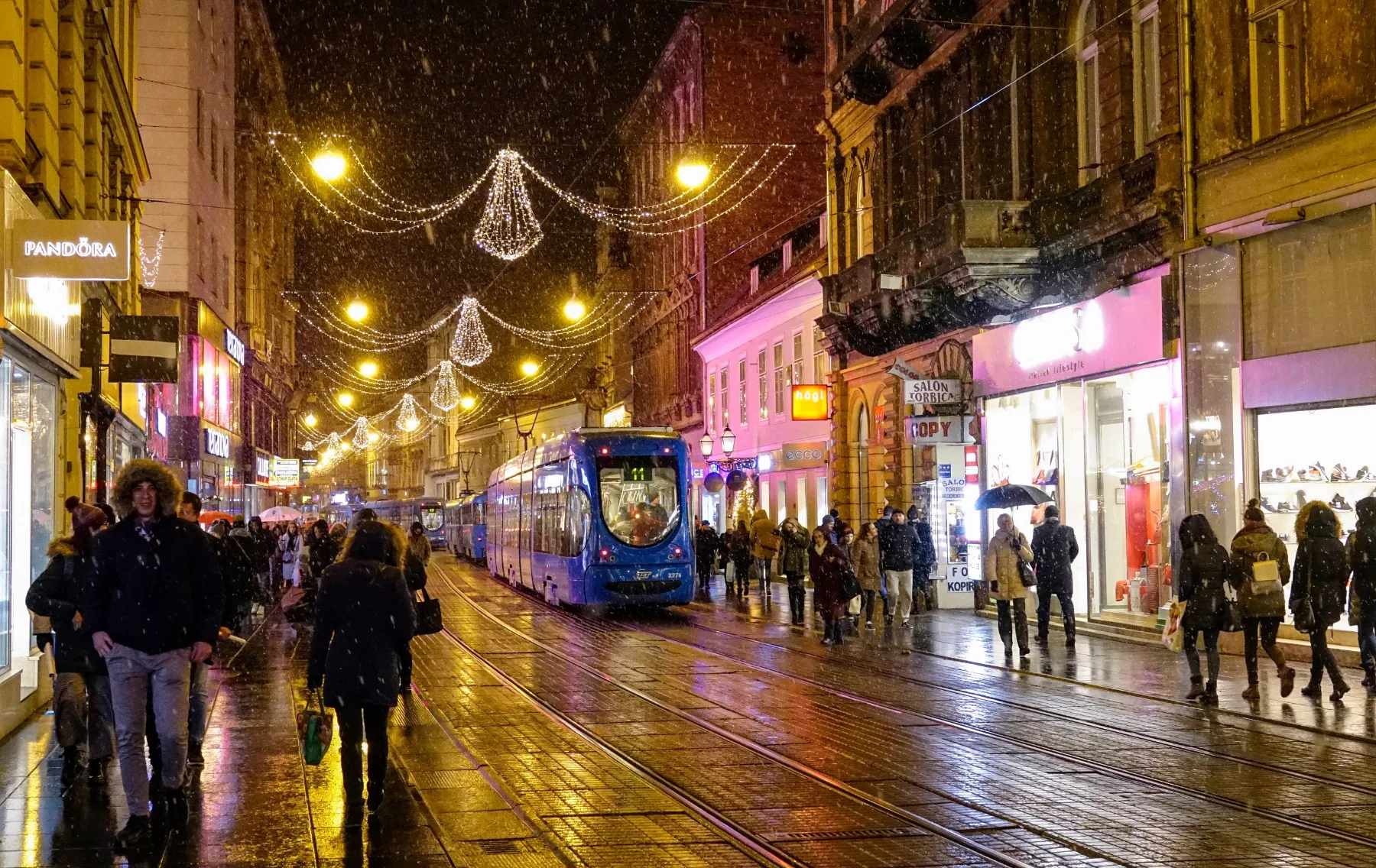
Advent Zagreb 2026 runs officially from 28 November to 7 January 2027, confirmed by adventzagreb.hr. Some locations may open three days early, from 25 November, in a soft-open period. The full location list spans more than 25 sites across Zagreb’s squares, parks and Upper Town. Walking all of it costs nothing. You pay for food, drink and anything extra, like the ice rink. That is the economic logic of the whole trip: fly in, walk the city, eat well, spend selectively.
Start at Ban Jelačić Square, the city’s main square and the natural anchor of the festival. It is where you get your bearings. From here, every other site is walkable.
Zrinjevac Park is the centrepiece. Over 40 white wooden vendor huts line the park, with a central music pavilion running daily live performances. The stalls sell hand-painted Licitar gingerbread hearts and hand-carved wooden toys, both UNESCO-listed Croatian cultural items. You are not buying souvenirs here so much as things that actually mean something. Baked štrukli, rolled pastry filled with cottage cheese, is cited by market guides as a Zrinjevac specialty, though it is worth checking on arrival which stalls are confirmed for the 2026 programme. Fritule, the small fried dough balls dusted with icing sugar, are the less ambiguous bet: they are everywhere, they are cheap, and they are good. In the 2025 season a standard cup ran €4 to €7; premium ‘Dubai fritule’ reached €11. Assume similar for 2026.
King Tomislav Square is where the skating is. The Ice Park here is the largest and most modern rink in Croatia, and the square has had a skating tradition since 1874. In the 2025 season, entry was €5 per hour at peak times, evenings and weekends, and €3.50 off-peak. The 2026 pricing had not been published as of October 2026, so treat those figures as a guide rather than a guarantee. Worth going for an hour regardless, if only because the setting earns it.
The Grič Tunnel is the one stop that has nothing to do with commerce and everything to do with atmosphere. A WWII-era underground passage beneath Zagreb’s Upper Town, it is transformed each Advent into an illuminated walkway. It takes about ten minutes to walk through and costs nothing. People throw their phones up trying to photograph it. Go anyway and look with your eyes.
On moving between sites: Zagreb’s city centre is compact enough that you can cover the main locations in a single long afternoon into evening. The natural sequence runs from Ban Jelačić Square through Zrinjevac, down to King Tomislav Square, then up through the Upper Town to the Grič Tunnel. Budget more time at Zrinjevac than you think you need. The performances at the pavilion make it easy to lose an hour.
For getting home late, the ZET night tram costs €1.99. That is not a rounding error. It is a working public transport network on a city that wants you to stay out. The taxis exist; the tram is better.
The one thing to skip: the premium fritule at €11. The standard version at €4 is the same dough, the same sugar, the same city. Save the difference for mulled wine.