Buying a professional photo camera is exciting, but it’s also very easy to make a mistake. Specification sheets are full of figures, each manufacturer says its autofocus is the best, and the prices range from a few hundred pounds to well over five thousand. The key point is that the right camera is usually the one that suits the work you actually do, not the one with the highest megapixel count.
What Makes a Camera “Professional?”
A professional stills camera is built around image quality. The most important features are resolution, dynamic range, autofocus accuracy and burst speed. Although video performance on these cameras is generally good, it isn’t their primary purpose. If you need a camera oriented towards filmmaking, look at a hybrid or a cinema camera. If your main concern is capturing a particular shot – a wedding kiss, a sprinting athlete or a mountain at dawn – then stills-first professional photo cameras are the best choice.
What’s Better: Mirrorless, DSLR or Bridge Camera?
This decision has mostly been made for you by the market. With mirrorless cameras taking up the largest part of the stills range, you can see where the industry is heading.
Mirrorless is the sensible choice for most photographers. It provides a live electronic viewfinder which displays the exposure before you press the shutter, offers better subject tracking, and has a wide variety of lenses available from all the major brands.
Some people still prefer DSLRs. Their lower prices make them an affordable option if you want to use interchangeable lenses. However, it is an older design, so you should not expect the autofocus precision found in a modern mirrorless camera.
Bridge cameras combine a fixed zoom lens with a smaller sensor. They are excellent for travel and for casual wildlife photography since you only need one light kit and never have to change lenses. The disadvantage is image quality in low-light conditions, where a bigger sensor is always superior.
Sensor Size: The Choice That Shapes Everything
Image quality, lens choice, camera weight and price are all influenced by the sensor size, so it’s worth understanding this before you spend a penny.
APS-C sensors are smaller than full-frame sensors, which means that cameras and lenses remain compact and the prices are lower. They are a great option for travel, street photography, documentary work and general enthusiast work.
Full-frame sensors collect more light, which helps in dark environments and gives you greater flexibility with depth of field. They also cope better with noise at high ISO settings. The disadvantage is that you have to use heavier and more expensive equipment, both in terms of the camera body and the lenses.
Don’t Forget the Extras
The camera itself is only one element of the expenditure. You also need a good lens, memory cards, spare batteries, a bag and a solid tripod.
Lenses
A reasonable guideline is to spend more on lenses. A simple camera body fitted with good lenses generally outperforms an expensive body with a bad lens. It will last longer than several camera bodies and has a greater impact on sharpness, background blur and performance in low light than most of the differences listed in the spec sheets. It is sensible to buy the camera in the form of a kit. However, you should remember that a kit lens is only a starting option. As your personal style evolves, you’ll most likely want a fast prime lens for taking portraits or photographs in low light, and maybe a telephoto lens if you shoot sports or wildlife.
Memory Cards
If you want to use a fast camera, you’ll need a fast memory card since otherwise you’ll reach the buffer’s limit when taking a series of shots and miss the moment. Find out what format your camera takes – nowadays cameras use SD, CFexpress or, in the case of some older models, XQD or CFast cards, and these types cannot be used interchangeably. Since higher-resolution cameras create large files, storage capacity is also important.
Batteries, Chargers and Grips
Since mirrorless photo cameras continuously use their screens and viewfinders, their battery life is shorter than that of a DSLR. It’s a good idea to carry at least one spare battery with you, and two if you are shooting throughout the day. Using a dual charger will save you time, and a battery grip will provide extra power as well as a more comfortable grip when you are using larger lenses or shooting a lot in portrait orientation.
Protecting and Carrying Your Kit
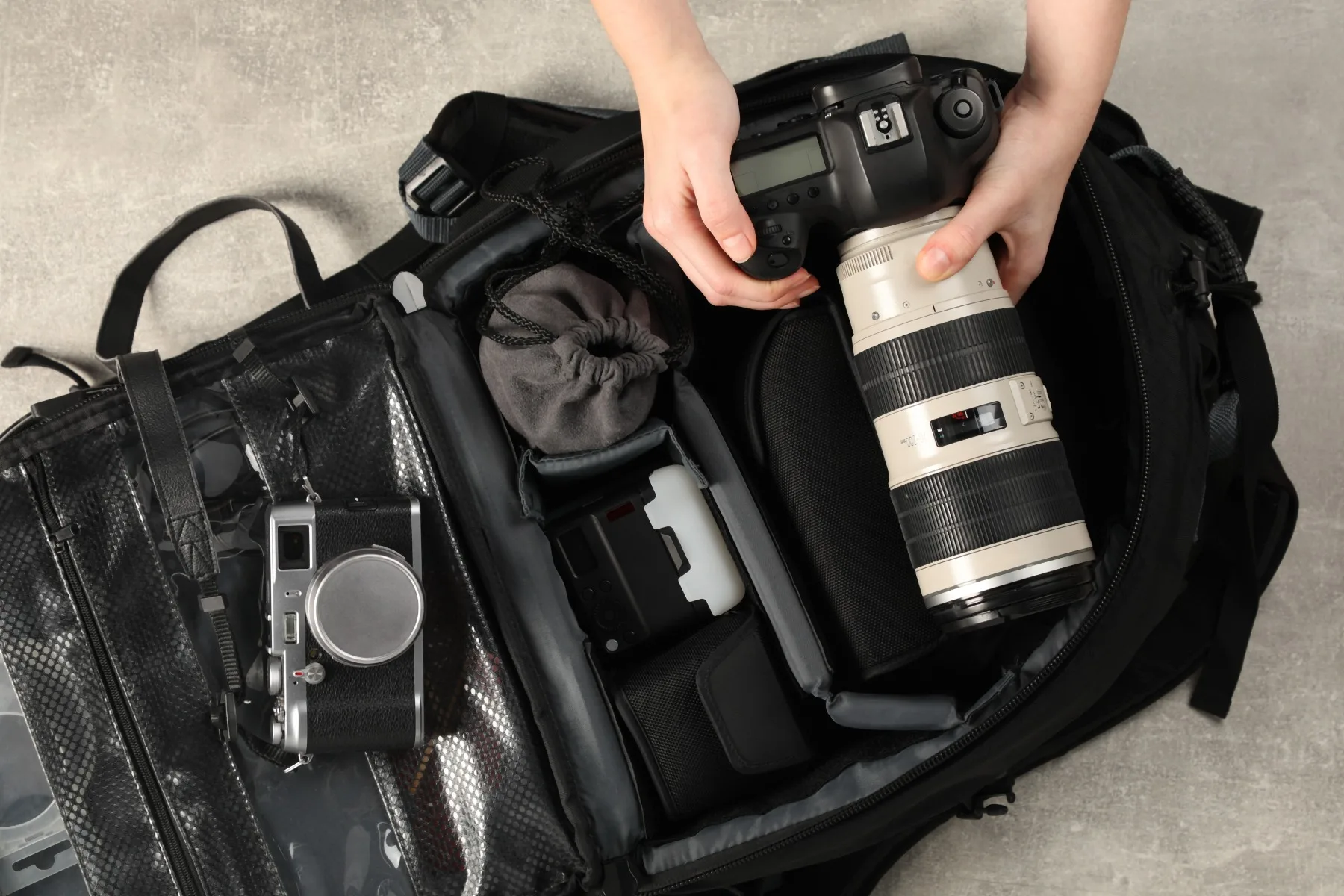
Good equipment should have appropriate protection; a backpack or shoulder bag with good padding will keep your belongings well organised and safe, and a hard case is the better option for travelling or transporting equipment. For people who work outdoors in the UK, a rain cover is a minor purchase which could save you a lot of money, and a comfortable strap is another useful feature, particularly when carrying a heavy camera body and a telephoto lens.
Support and Light
A tripod is critical for taking landscape pictures, night photography and studio photography sessions. Choose one that matches your heaviest lens and is not too heavy to carry. A monopod is a cheaper solution for sports and wildlife photography, reducing weight without extra bulk. When it comes to lighting, a flashgun gives you a lot of possibilities, from fill flash outdoors to bounced light indoors.
Try Before You Buy
The specifications don’t tell the whole story; you can only judge how a camera feels in your hands, the way its menus operate, and whether the grip is suitable by trying it out yourself. If you have the opportunity, go to a showroom and hold a few cameras you’re considering at the same time. When you buy from a UK dealer, you also receive the full manufacturer’s warranty.
The Short Version
Choose your body based on what you shoot, but pick your mount and lenses just as carefully. Then budget properly for the extras: fast cards, spare batteries, a sturdy bag and a decent tripod. It’s the complete kit, not the camera alone, that produces good pictures.