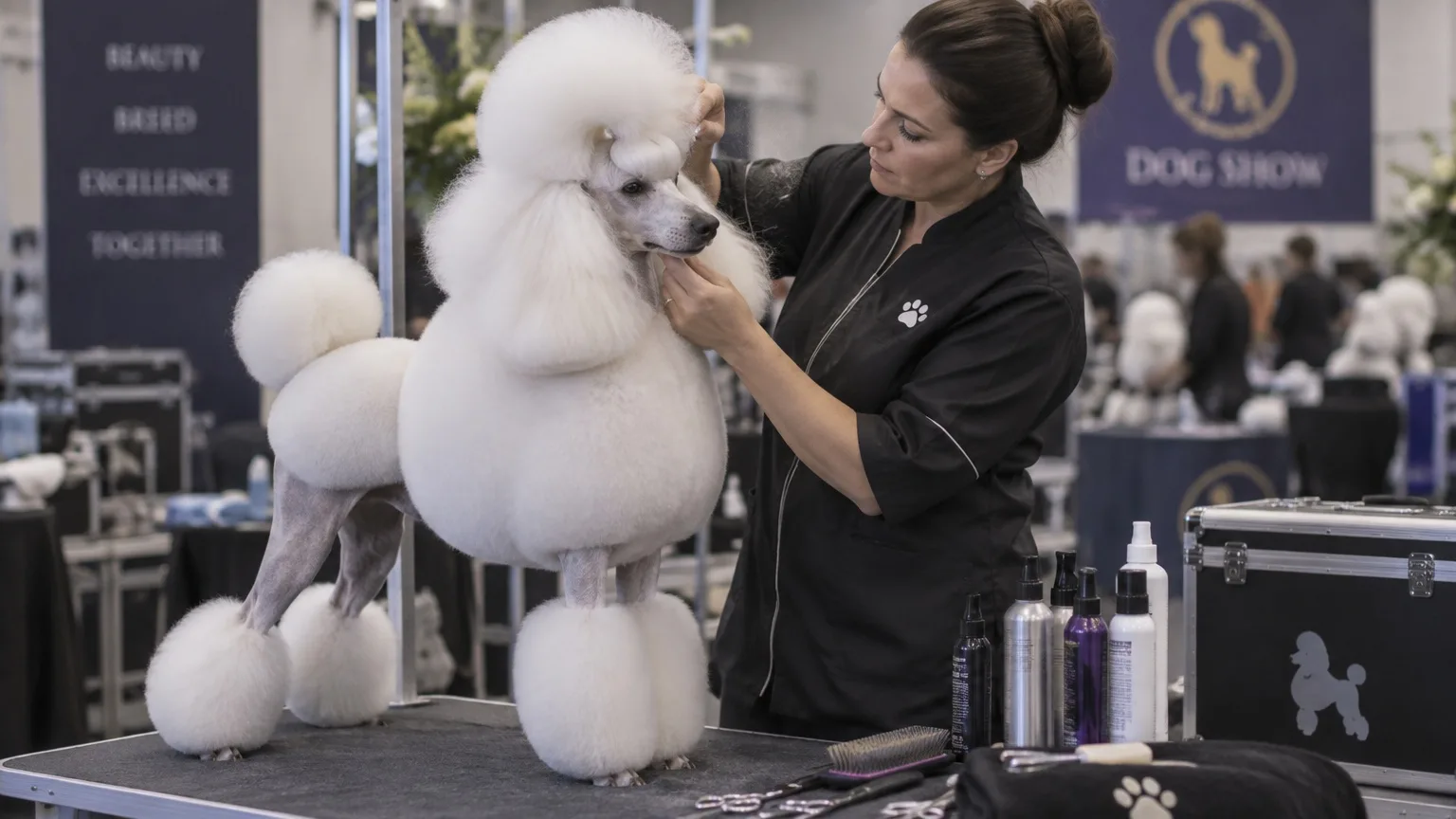
Somewhere in a convention centre that smells of hairspray and dog, a woman is blow-drying a standard poodle’s hindquarters into the shape of a bison. She has been awake since 4am. She is not doing this for fun. She is doing this to win.
Creative grooming, or “creative styling” as its practitioners insist on calling it, is the competitive end of the dog grooming world where the brief long ago stopped being “tidy up the dog” and became something closer to “turn the dog into a piece of performance art that will destroy your rivals.” Poodles are the preferred canvas because their coats grow fast, hold dye, and can be clipped into almost any shape without lasting damage. The dogs, for what it is worth, appear largely unbothered.
The competitions are structured events with formal judging categories, time limits of roughly two to four hours, and prize money that, for most people in the room, does not come close to covering the dye, the stencils, the travel and the entry fees. Top placings can run to a couple of thousand dollars, but the economics only work if you win, and most competitors do not. Groom Expo in Hershey, Pennsylvania and Intergroom in New Jersey are the closest things the US industry has to a world championship, with European equivalents in the UK, Germany and the Netherlands. The top names travel the circuit internationally, and the social media rivalries between them are vicious in the way only niche subcultures can manage.
Techniques have escalated to a point that needs explaining. Groomers use pet-safe dye in colours that would embarrass a festival wristband. Sculpted topiary sections are built up with product and pinned mid-groom. Some competitors use airbrush kits to add shading and detail. A themed entry might feature a poodle whose back half is a shark, complete with painted scales and a fin that took twelve hours of prep. The dog is walked into the ring, judged on creativity, technical execution and overall impact, and then presumably taken home and stared at for a fortnight.
The people who do this are not, as you might assume, eccentrics with nothing else going on. Many are professional groomers running successful salons who compete the way a chef enters a culinary competition: to test their skills, build their reputation, and, yes, absolutely crush everyone else in the room. The scene has its own hierarchy, its own feuds, and its own YouTube rabbit holes that will cost you an evening if you make the mistake of starting one at 11pm.
The ethical debate is real and worth knowing about. Critics argue that dyeing and hours of styling stress the dog even when the products are non-toxic. Proponents point to the handling requirements: a dog that cannot tolerate long grooming sessions, loud rooms and strangers prodding it does not compete at this level, which means the animals involved tend to be exceptionally well-socialised. Both sides make fair points. Neither is going away.
What is not in dispute is that the results can be astonishing. A poodle as a My Little Pony. A poodle as a Roman centurion with a sculpted helmet. A poodle whose whole body has been worked into a topographical map of Middle-earth, Mordor somewhere around the tail. These images do the rounds every few months to the bafflement of everyone meeting them fresh, and to the quiet satisfaction of the people who made them.
If you want to see it live, lower your expectations first. The two flagship US shows are trade-only: Groom Expo, which runs every September in Hershey, and Intergroom, which runs each spring in New Jersey, both state plainly that only pet professionals may attend, so you cannot just buy a spectator ticket at the door. For everyone else, the realistic routes are the consumer pet expos that host creative-grooming competitions and do let the public in, or the internet, where the results circulate anyway and cost nothing but an evening you will not get back.