The modern office faces a tough challenge. One employee needs silence to finish a report, another leads a video call, and a nearby team brainstorms its next project. All three activities might happen within the same open-plan workspace.
Flexible layouts make offices more adaptable, but they also create noise challenges. Conversations carry, video calls become distracting, and hard surfaces let sound linger.
Research into workplace design and acoustic comfort highlights the value of controlling sound while giving employees different spaces for different tasks. The answer isn’t necessarily building more walls. It’s making better use of existing furniture, surfaces, and layouts.
Why Modern Offices Need Better Sound Management
Traditional offices often separated employees into individual rooms or fixed departments. Today’s workplaces more often combine shared desks, collaborative areas, meeting spaces, and informal seating.
This flexibility can help businesses use space efficiently. Yet it also means activities with different noise requirements frequently overlap.
An employee reviewing financial documents might sit near colleagues discussing a project. Someone attending a hybrid meeting could struggle to hear remote participants over nearby conversations.
The challenge isn’t simply how loud an office becomes. It’s also how sound behaves within the space.
Hard materials such as glass, concrete, and exposed ceilings reflect sound rather than absorb it. These reflections create reverberation, making conversations overlap and reducing speech clarity.
Modern office acoustic solutions address these challenges by incorporating sound management into furniture, architectural features, and workplace surfaces.
Rather than treating acoustics as an afterthought, businesses can make sound control part of everyday office design.
This approach recognizes that different activities require different conditions. Collaborative areas should support clear conversations, while focused workspaces need fewer distractions.
How Furniture and Surfaces Can Improve Office Acoustics
One advantage of integrated acoustic design is that businesses don’t necessarily need additional rooms to manage noise.
Many treatments serve multiple purposes, providing practical functionality while improving comfort.
Acoustic furniture and desk dividers
Upholstered seating, high-backed booths, and acoustic desk screens can absorb sound while separating employees.
A high-backed seating booth, for example, can provide a setting for informal meetings while reducing sound reflections.
Desk-mounted panels can also separate individual workstations without permanent partitions. These features help teams that frequently change seating arrangements or collaborate across departments.
Wall and ceiling treatments
Walls and ceilings offer opportunities to improve acoustics without reducing usable floor space.
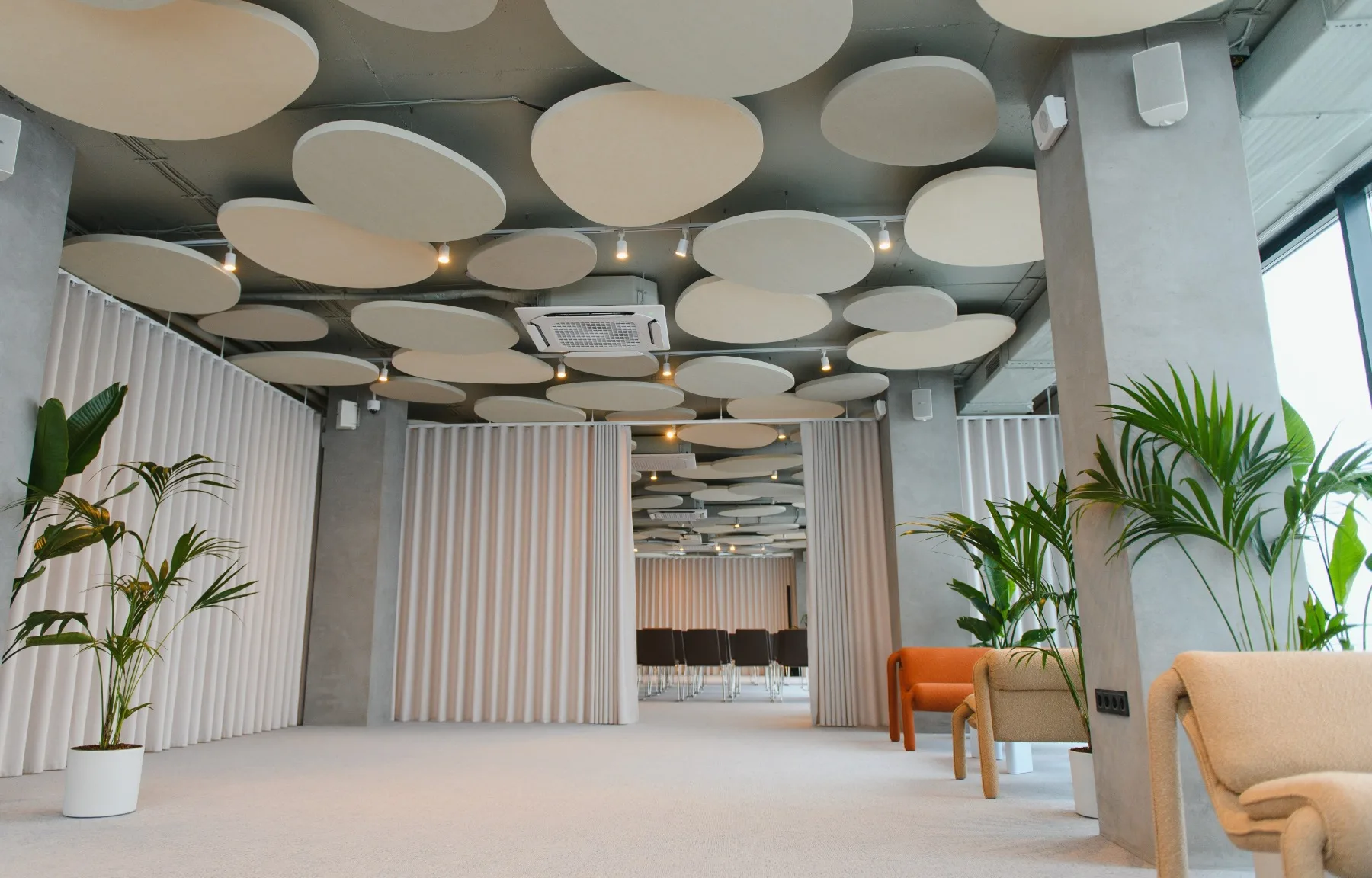
Sound-absorbing wall panels reduce reflections, while ceiling baffles and suspended acoustic elements help manage reverberation across larger areas.
These treatments also come in different colors, textures, and finishes, allowing businesses to maintain their preferred aesthetic.
Some designs even turn acoustic treatments into decorative features, adding visual interest while improving sound quality.
Multifunctional partitions and storage
Storage units, shelving, and movable partitions can help establish boundaries between activities.
For example, a storage wall might separate a busy collaboration zone from individual desks.
Combined with sound-absorbing materials, these features can reduce reflections and interrupt direct sound paths.
Still, sound absorption and sound isolation are different. Acoustic panels reduce reverberation but cannot guarantee confidentiality or prevent every conversation from being overheard.
Sensitive meetings may require enclosed rooms with suitable sound-isolating construction.
The goal is to match acoustic treatments to workplace needs rather than expecting one product to solve every problem.
Creating Workspaces That Support Different Activities
Effective acoustic design begins with understanding how employees use their workplace.
The U.S. General Services Administration’s workplace guidance highlights the role of acoustic comfort in creating healthier, more functional buildings. Combining sound absorption, physical barriers, and appropriate background sound can help address different workplace needs.
Instead of applying identical treatments everywhere, businesses can divide their space into activity-based zones.
Place focus areas away from busy walkways, communal kitchens, and meeting spaces. Acoustic screens and absorbing ceiling treatments can help reduce distractions.
Collaboration zones need environments that support natural communication. Sound-absorbing finishes help prevent conversations from becoming excessively reverberant.
Hybrid meeting spaces benefit from clear speech and limited background noise. Wall treatments, appropriate ceilings, and careful microphone placement can improve communication for everyone.
Breakout areas can accommodate casual discussions without sending unnecessary noise across the office.
The GSA’s workplace renovation guidance also highlights sound-absorbing flooring, acoustic ceilings, and appropriate wall systems as ways to improve sound management.
Flexibility matters when selecting these features.
Movable screens and modular furniture allow businesses to adjust layouts as teams grow. Permanent acoustic treatments can support areas that consistently need sound control.
Employers can also ask staff where noise causes the greatest difficulties before making changes. Identifying recurring problems helps avoid investing in treatments that don’t address actual distractions.
For more complex spaces, an acoustic specialist can assess reverberation, speech privacy, and sound transmission before recommending improvements.
A Better Office Doesn’t Have to Mean a Bigger Office
Making a multifunctional workplace effective isn’t simply about fitting more activities into one floor plan. It’s about helping those activities happen without constant interruptions.
Acoustic furniture, wall treatments, ceiling systems, and flexible partitions can create comfortable spaces that support different ways of working.
These improvements can also preserve the open appearance and adaptable layouts that make contemporary offices appealing.
The key is treating acoustic performance as an essential part of workplace planning, alongside lighting, furniture, and technology.
When sound is managed thoughtfully, employees gain an environment that better supports concentration, conversation, and collaboration without requiring more space.