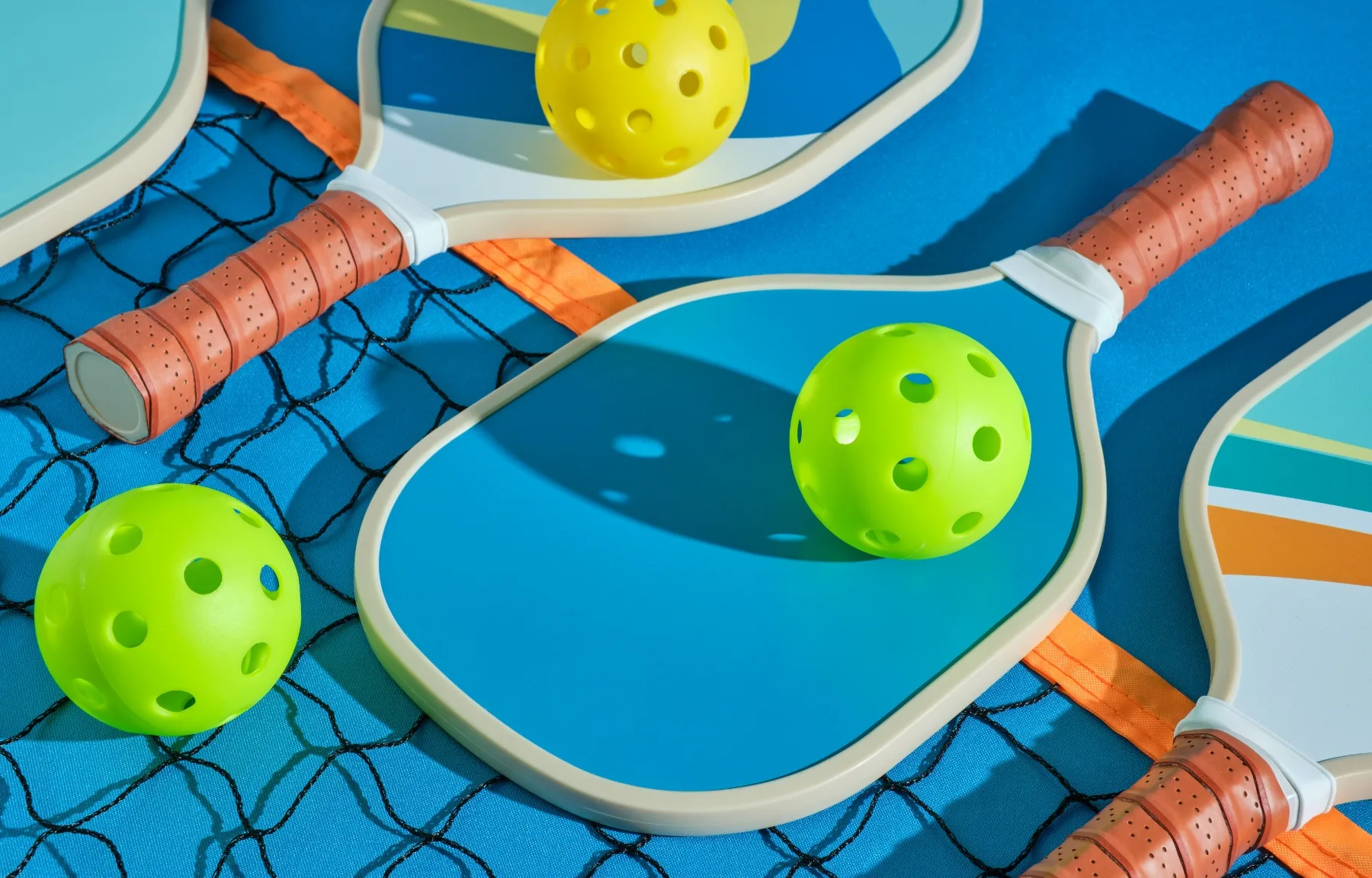
Walk past a public tennis court in Britain right now and there is a reasonable chance you will find four pickleball courts painted over the top of it, eight people whacking a plastic ball with paddles the size of a frying pan, and one furious tennis player standing at the gate wondering what happened to their booking. Welcome to sport’s pettiest turf war, and it has well and truly arrived here.
Pickleball has been steamrolling American tennis infrastructure for years. An analysis by the New York Times found that more than 26,000 pickleball courts were built between 2019 and 2025, with most occupying spaces that had previously been used exclusively for tennis. The economic logic is not hard to follow: more revenue can be made by companies with less space when one tennis court can turn into as many as four pickleball courts. Britain, being Britain, is arriving slightly late to the argument but arriving with full commitment.
The LTA already tells venue owners how to convert their courts, and there are over 270 pickleball courts in Great Britain at last count, though that number is moving fast. What began with 305 players and 694 event registrations has evolved into 2,350 players and 4,321 registrations in 2025, and 2026 is set to raise the bar once again. The sport now has genuine institutional backing. The home nation sports councils have recognised pickleball as a sport and Sport England has recognised Pickleball England as its national governing body in England. That happened in December 2024, after the LTA tried and failed to absorb the sport under its own umbrella, arguing that its relationship with over 15,000 registered venues and 1.5 million tennis fans could be hugely beneficial to pickleball. Pickleball England, which has been running since 2019, told them where to go, politely.

The tennis lobby’s grievance is not really about governance. It is about courts. Noise complaints, court-space disputes, and tennis traditionalists dismissing pickleball as “baby tennis” have all fuelled tension between the two racket sports. The jockeying over court space has descended into social media videos making fun of both sides, and tennis players like to make fun of pickleball players’ perceived lack of athleticism. In the US, warring racquet factions in one gated community in West Palm Beach formed LLCs to take each other to court, the legal kind. That level of aggression has not yet reached Surbiton, but give it time.
Then there is the noise. This is where pickleball genuinely has a problem. While the paddle hitting the ball averages 70 dBA, it is still greater than tennis’s average 40 dBA. Unlike the strings of a tennis racquet, which absorb energy, a hard pickleball paddle acts as a soundboard projecting noise outward, and the hard plastic ball creates a high-frequency “pop” upon impact. Pack four courts into the space of one and you have multiplied that pop considerably. The sport’s growth has collided with residential zoning, public parks, and local noise ordinances, turning what used to be a small complaint into lawsuits, court closures, and heated public meetings. Britain is already dealing with this through padel, which faced planning rejections across Bath, Weybridge, and Winchester over nearly identical noise arguments. Pickleball is louder.
The pickleball crowd’s counter-argument is reasonable enough. Pickleball is growing faster than tennis, reaching a record 24.3 million players in 2025, but tennis was not shrinking either. It grew and broke its own record, reaching 27 million players the same year. Both sports are expanding. The real problem is that publicly funded court space in Britain has not kept pace with either, so the two are being forced into the same square footage and told to sort it out between themselves.
For now, the LTA’s position amounts to an awkward embrace: it publishes guides on converting tennis courts to pickleball, promotes the sport to its venue network, and quietly hopes it can monetise what it could not govern. Whether that keeps tennis players patient is another matter entirely. The ones being squeezed off public courts on a Saturday morning are not especially interested in the institutional politics. They just want to play.