Publication Date
READ TIME
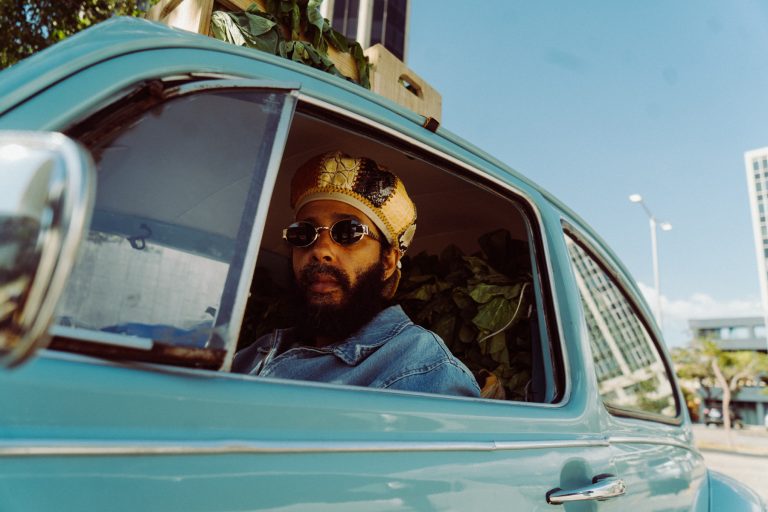
We caught up with ‘Samory I’ for an exclusive interview from his home in Jamaica, as he prepares for his performance as Reggae Land 2026.
Samory-Tour Frazer, known as ‘Samory I’, grew up in Kencot, one of Kingston’s rougher neighbourhoods. He was named after Samory Touré, the West African ruler who resisted French colonisation in the late 19th century. Music came early. He sang in church as a child, performing at functions and, according to those who were there, reducing congregations to tears on more than one occasion.
His 2017 debut album Black Gold, produced by Rory “Stonelove” Gilligan, broke him into the reggae mainstream. The lead single Rasta Nuh Gangsta has pulled in over 10 million YouTube views and 6 million Spotify streams. Since then, he’s featured on two Grammy-nominated albums: Jesse Royal’s Royal (the collaboration High Tide or Low) and Protoje’s Third Time’s The Charm (the closing track Heavy Load). His second album Strength (2023), produced by Winta James, made Rolling Stone’s 100 Best Albums of the Year list.
His third, Revelation, dropped on 29 May via TunUp Squad Entertainment, produced by Clive Hunt. It features Chronic Law, Agent Sasco, Govana, Keznamdi, and Baye Gallo. It came from a difficult place. “I was in my darkest time,” he says. “My lowest moment. I was going through depression. I never wanted nothing to do with music. I just wanted to be alone in my dark space.” It was people around him, including longtime collaborator Potarice, who encouraged him to go back to the studio. “While working, I got to see myself. I learned a lot about myself during that time.” Did the process help? “Life is amazing,” he says.
There’s a track on the album called Letter to My Son, addressed to his six-year-old. “My pride and joy,” he says. “Take my time and enjoy these moments now.”
I ask what he’d have done if music hadn’t been an option. “I come from the gutter,” he says. The options were against him from the start.
“The word is the word, and great is them that publish it,” he says. “Love and truth, and rights to the people.”
Reggae has been pulled in different directions over the past two decades. Dancehall and roots went their separate ways. Artists like Chronixx and Protoje carved something in the middle. Samory’s sympathies are with the purists who think roots music should remain as it is, but he’s pragmatic about reaching a younger audience.
“The reason why we sing the type of music we sing sometimes is because we try to appeal to a younger audience,” he says. “So I mix the roots with the hip hop or the dancehall or even soul music.” But the substance stays the same. “The message is still the message just because we mix the music with other things. The message is, and will always be, the message.”
The Jamaican scene specifically? He’s less upbeat. Dancehall dominates radio. Roots music gets played at dances, but not enough. A track like Victory, his collaboration with Chronic Law, gets play partly because it sits on dancehall-adjacent production, and that’s one reason artists like him make music on those kinds of beats.
It’s how you get the message heard. The music is in good hands, he says, but the audience has a part to play. “The people need to open their hearts to receive the music. It comes from a powerful place, a place of hardship and strain. And we are sometimes barely rewarded for the work we do.”

The broader picture isn’t much brighter. “Old people try to stay in the job 100 years, waiting for their family to come take their positions,” he says. “There’s no opportunity for the youth because the government creates opportunity for other government parties and the rich people, not for the poor people.” The same people control the music and the government. “These people put these people in power because it benefits them.”
He’s not convinced change is coming either. “There’ll never be a change. Once the government puts food in certain people’s mouths while certain people are hungry, and it benefits the government to do so, it won’t change. Unless the people themselves make a change.”
He’s less concerned about the industry side of things. When I ask about the politics of music distribution in Jamaica, he steps around it. “My message have to be heard,” he says. “I will never fight to be the one in the spotlight or to be the one up front. I will be great.” He frames it in biblical terms: “The Bible say all singers and players of instruments will be there. So I don’t worry about what is going on now.”
His creative process is simple. He prays before the session. The producer plays a beat. He catches the melody, goes home, writes the song, comes back the next day and sings it. Sometimes he writes in the studio, particularly when he’s working through something difficult. “I know people would feel the music.”
He sent Chronixx a WhatsApp a few weeks before our conversation just to tell him. A collaboration is something he’s trying to make happen. He’d also love to work with Damian Marley.
He’s heading to the UK this summer for Reggae Land at Milton Keynes National Bowl, now in its sixth year and sold out since February. The festival has grown into the biggest reggae and dancehall weekend in the UK, with over 120 artists across seven stages. Burna Boy headlines Friday.
Saturday’s main stage is topped by The King & The Royals, the new supergroup pairing Beenie Man with Morgan Heritage for their world debut. Samory I plays the One Love Stage on that same Saturday alongside Richie Spice, Ken Boothe, and Jesse Royal, who he’s previously collaborated with on the Grammy-nominated album Royal.
It’s his first time at the festival, and there are hints of other UK shows being arranged around the same dates, though he can’t say more yet. His only previous UK festival was Boomtown. “That was a mad vibe,” he says. “Energy. Let’s go.” He’s bringing his band, Full Circle, who played with him at South by Southwest. “Can’t wait for the people. Believe me.”
Performing is both love and business. “Get the praise and get the raise,” he says. Touring gives him space. “I meditate, not by sitting in a corner doing anything, but just chilling in the space, reminiscing. And then work to do, and the opportunity to do the work again.”
Looking ahead, there’s unreleased material from the Revelation sessions that will come out as singles first, then a mixtape around late December or early January, followed by another album by next June. The direction? “A straight roots album.”
When asked to pick one track that defines him, one that defines another artist, and one he’d delete forever, he declines the last option. “I don’t want to be the man to take away anybody’s music.” For himself, he picks There’s a Spirit and Zion from Revelation. For another artist, Saviour by Chronixx.
Before we hang up, I ask what he’s doing with the rest of his day. “Picking up my son from school.” And then, as a sign-off: “My name is Samory I of Revelation.”
Links
You can find out more about Samory I and the other performers at Reggae Land 2026 here
https://www.instagram.com/official_samory/
https://www.facebook.com/samoryi
https://www.youtube.com/@samoryi