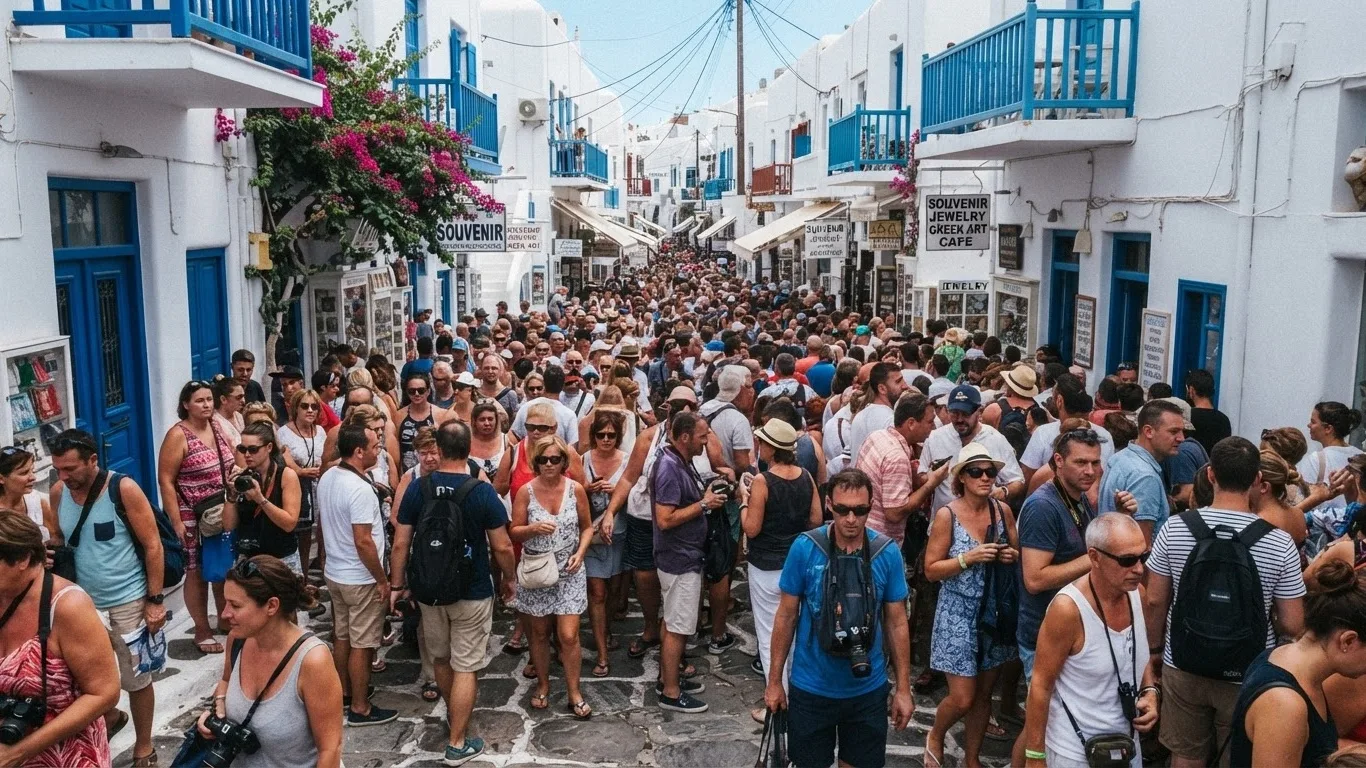
Corfu spent €11 million in 2024 shipping its own rubbish to mainland incinerators. The island’s waste system was built for 100,000 residents. In peak season 3.3 million visitors turned up. The bins overflowed. The ferries hauling the rubbish away cost more than most small municipalities spend on roads.
That is one number from one island. Greece took 37.98 million visitors in 2025, up 5.6 per cent on the year before, and pulled in €23.6 billion in travel revenue. The money is real. So is the rubbish.
The government has moved on both, with more conviction on one than the other. Santorini now enforces a hard daily cap of 8,000 cruise passengers, run through a berth-allocation system managed by the Municipal Port Fund of Thira. For 2026 the cap got tighter without the headline number changing: ships are counted at 100 per cent of stated capacity instead of 80. A vessel carrying 3,000 passengers now takes 3,000 of the day’s 8,000 slots, not 2,400. The island’s own berth system shows the result: 595 cruise ships scheduled for 2026 against 728 the year before, an 18 per cent drop. Nobody moved the ceiling. They just stopped discounting the ships underneath it.
A disembarkation levy followed. Since 21 July 2025, every cruise passenger stepping ashore at Santorini or Mykonos between June and September pays €20 per port call. Touch both islands and that is €40 in levies before you buy a coffee. The charge falls to €12 in April, May and October, and €4 in winter. Every other Greek port charges €5 at peak. The two islands have been quietly filed as a separate class of problem. Greece’s 2025 draft budget put the levy’s take at about €52 million a year. Kyriakos Mitsotakis has said some of it will pay for a second port at Santorini, near Monolithos on the eastern coast, to take load off the caldera.
Mykonos has 10,704 permanent residents. In 2024 it took roughly 2.2 million visitors. That ratio is not a planning failure. It is a planning choice made over decades, and a levy does not undo it. It just prices it.
The thing that could actually slow the spread of beds and terraces and infinity pools spent most of this year on a desk in Athens. It is off the desk now. On 7 August 2026 the government signed the new Special Spatial Framework for Tourism into law, sorting all 1,035 of Greece’s municipal units into five saturation tiers. Santorini, Mykonos, Skiathos and parts of Corfu, Rhodes, Kos, Zakynthos, Tinos and Crete sit in Category A, the 18 most restricted areas. New accommodation there is capped at 100 beds per development, on a minimum plot of 1.6 hectares, with a carrying-capacity assessment before anything breaks ground and no new building within 25 metres of the coastline.
The catch is in the timing. Any project that already held a building permit or a completed environmental file before the cut-off is exempt, so the beds already in the pipeline still get built. And the mayors of the islands it targets say 100 beds is 100 too many. Santorini’s mayor, Nikos Zorzos, put it plainly: the island does not need a single extra bed, and a 100-bed hotel on a 1.6-hectare plot does nothing to protect the view.
So the caps hold. The levy collects. The framework is signed. Greece has worked out what it costs to arrive, and it has finally written down how many places there will be to stay. Whether that number bites where the pressure actually is, on the islands already full, is the part still being argued.