Hiking and tackling two Via Ferratas
with an iron will in Switzerland’s Valais region
Clip. Unclip. I’m at a lofty height in Saas-Fee, Switzerland, tackling a via ferrata in a full harness ensemble. I’ve decided to take on a far more thrilling way to discover the mountainous area heading towards Saas-Grund. And my head is spinning – in a good way – I’m mesmerised. I’m hanging off a cliff face and am afforded views of natural canyons, caves, waterfalls, and alpine vegetation that wouldn’t have the same feel had I opted for a bog-standard hike or a bike ride.
Via Ferrata translates as ‘iron path’ and refers to a route along a cliff face clad with rungs, ladders, and suspension bridges to assist climbers through the mountains. A metal cable runs alongside the route, so you never have to figure out if you’re on the correct path. The activity is a sweet spot that falls somewhere between hiking, climbing, and mountaineering. It’s a real adventure, and just when I thought things couldn’t get spicier, my guide instructs me on how to tackle a pendulum swing.
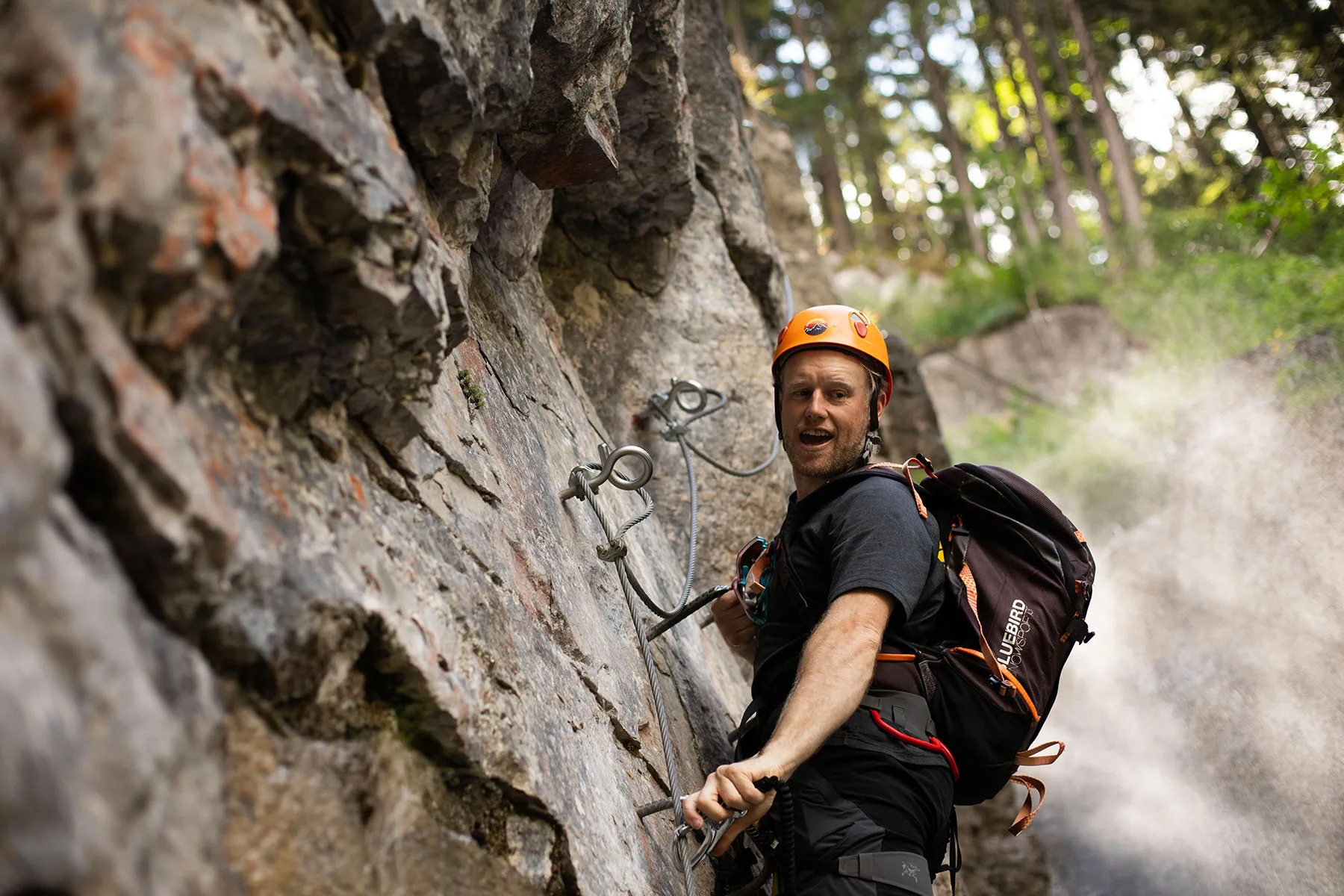
Image Credit: Barbara McCarthy
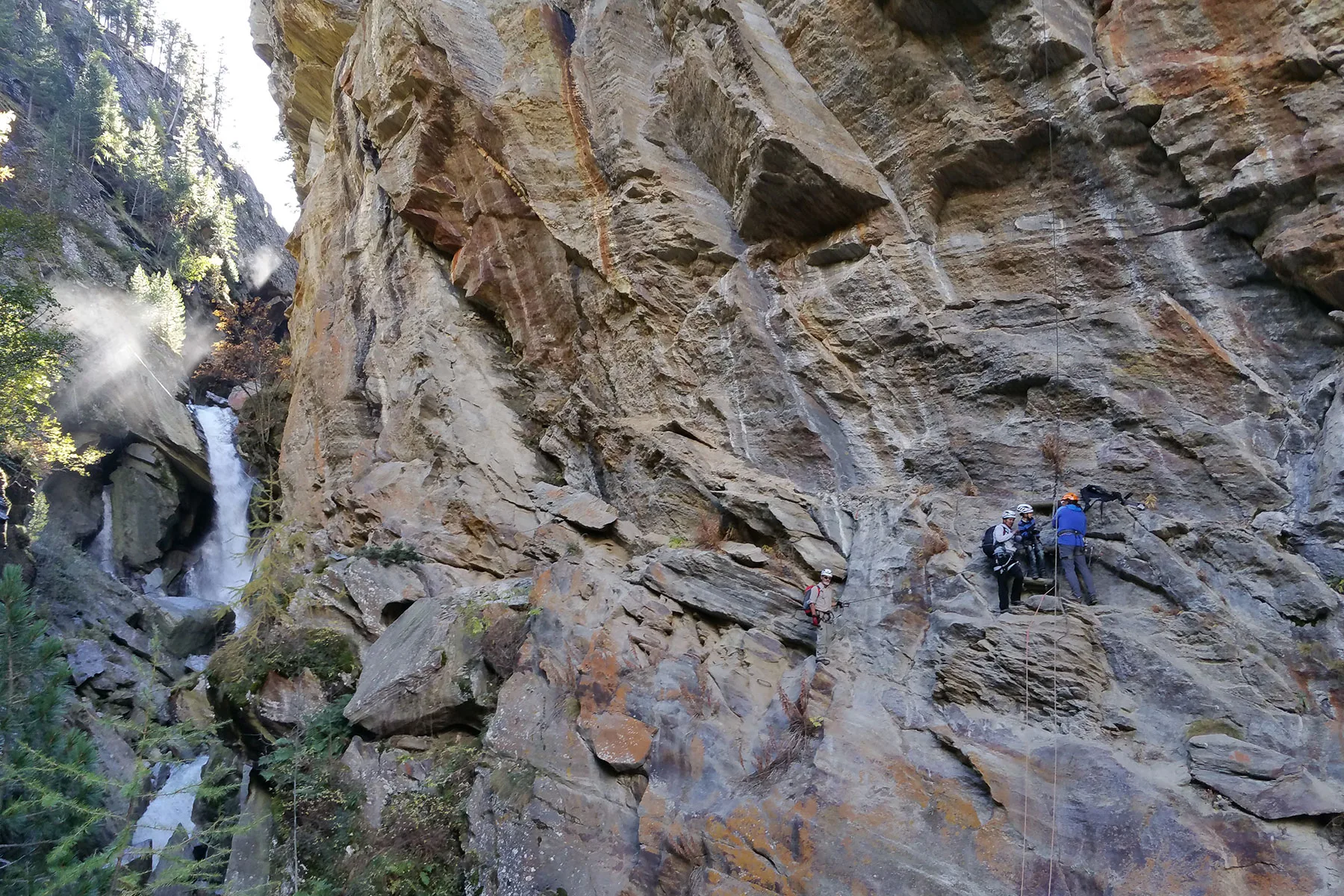
Image Credit: Barbara McCarthy

Image Credit: Barbara McCarthy
This spectacular tour from Saas-Fee to Saas-Grund is by far the most beautiful and thrilling way of connecting the two villages. For hundreds of years, people only dared to glimpse into the depth of the Saaser Vispa canyon. But now, adventure junkies can glide down its centre with the help of iron, ropes, zip lines and ladders.
Via Ferrata was invented in the Dolomites by the Italian army. The Italian and Austrian troops needed to move from one side to the other with heavy equipment. To make things easier, they erected cables and rungs to help pull themselves along. Today, via ferratas have become a popular leisure activity.
While you can admire this ski region at 3600 meters above sea level, back on the ground, Saas-Fee has a lot to offer. It’s a car-free, eco-sustainable resort, and quite compact. The majestic mountain scenery can be seen from everywhere. Choose to admire them from an array of alfresco restaurants, coffee shops, or just walking around.
When you need to prop your feet up, you can simply relax in one of the many spas and wellness baths dotted around. We overnighted at the labyrinthine Walliserhof Grand-Hotel & Spa and made use of its stunning, seemingly endless spa and sauna complex. It’s where George Michael and his clan stayed while filming the video for his hit ‘Last Christmas’ in 1984.
For a more affordable relaxation option, set your bare feet in the Aqua Allalin and soak in the whirlpool, jacuzzi and outdoor spaces while indulging in the views and mountain panoramas surrounding you.
Having had my fill of via ferratas (for now at least), I’m happy to continue my journey higher up in the mountains on foot. I take the cable car to Felskinn to hike to the Britanniahütte or Britannia Hut.
This is a high-altitude hike in the middle of a magnificent glacier world, starting from Felskinn station. It leads across the alpine plain of Morenia to the Egginerjoch before the path branches off to the right heading south to the Britannia Mountain Hut at 3,030m.
With so much to take in along this undulating path, my group are in no rush to summit. There are rocky sections to contend with and partially snow sections to trample over. While the trail is not busy, fortunately, the boot prints left by previous walkers along the snowy sections make it easier to walk on.
When I was promised unforgettable views over the Allalin glacier and the Mattmark area and its eponymous reservoir – Europe’s largest natural reservoir, I’m not sure what I was thinking. Because the view that unfolds after summiting Britannia Hut is nothing short of magical.
The Saas Valley region is surrounded by 18 four-thousand-metre mountains. And as I breathe in fresh air, taking in the imposing peaks, I imagine this setting in winter. Why? It’s this snowy landscape that served as the backdrop for pop group Wham’s video ‘Last Christmas’. And it’s nothing short of spectacular in the summer.
Britanniahütte is one of the most visited Swiss alpine huts in the Alps and marks the start of the legendary Haute Route. Renovated in 1997, it offers 134 beds in a hostel-style environment with three dining rooms. Solar energy delivers the power for the lighting and phones, while the hut collects snowmelt and rain. Preserving the environment is paramount. Rubbish is separated and flown down to the valley by helicopter along with wastewater.
After diving into a delicious three-course hot meal (served daily at dedicated times) and a good night’s rest, my group descends the mountain the following day. A couple of my group braved a dip in one of the many lakes along the route.
The transport system in Switzerland is nothing short of epic because everything runs with precision. It’s worth purchasing the Swiss Travel Pass that whisks guests to the most beautiful places in the country on flexible and affordable public transport with Swiss efficiency.

Image Credit: Barbara McCarthy

Image Credit: Barbara McCarthy

Image Credit: Barbara McCarthy
I’ve extended the trip and head to Champéry in lower Valais, some three hours away. The final leg of this journey is simply beautiful as we wind around mountains, allowing the scene to unfold through the train’s windows.
Located in the huge skiing area of ‘Les Portes du Soleil’, Champéry in the Val d’Illiez, although resolutely modern, manages to preserve much of its traditional charm. It became the first Olympic Village in Valais, after hosting the curling events for the Youth Olympic Games – Lausanne 2020.
Walking along its quaint picturesque main street after dropping off our bags at the basic but delightful Hotel Suisse was a joy, not least to stretch the legs but to check out the shops, cafes and restaurants. If you’re looking to sample traditional cuisines from this area, I can highly recommend the cosy Café du Nord. Centrally located, it offers simple meals with a focus on cheese.
Adventure awaits the following day as I psyche myself up for my second via ferrata of the trip. Tière Via Ferrata is part rock climbing, part hiking and is a sensational way to explore rugged alpine terrain. We enlist the help of Lloyd Wiltshire, a Brit, who set up his company Experience Champéry in the early noughties. Depending on the season, Lloyd and his team help visitors get involved in various activities.
But we’re here to combat the Tière Via Ferrata which is 460 m long and has an altitude gain of 140 m. Skimming up sheer rock walls that can attain a vertiginous 75° grade. The excitement builds up as we take a leisurely 40-minute hike passing meadows, forests and gentle streams until we reach the departure point of ‘Sous-Scex’.
Unlike the Via Ferrata in Saas Fee, this one is far more challenging and not for the faint-hearted. But Lloyd’s calm nature helps overcome any doubts I have about being able to complete the circuit. I wrongly thought via ferratas were all about upper body strength but I find myself recruiting my entire body. It proves to be a mental as well as a physical challenge as I navigate my way up and around the cliff face like Spiderman.
The juicy part comes when the route crosses over the River Tière in two places using suspension bridges and walking the tight rope. Offering spectacular views of the rushing cascades below, I stop to take it all in. I commit these sights to my memory bank. I’m almost deflated when we reach the end of the via ferrata at 1,190m altitude. I want to do it all over again!
But adventure abounds in Champéry. The town’s iconic red and white cable car takes visitors to an altitude of 2,000m in just five minutes to Portes du Soleil.

Image Credit: Barbara McCarthy

Croix de Culet restaurant is a great place to stop to have a bite to eat and admire the surroundings. I walk around the terrace while waiting to be served (the restaurant serves BBQ style food alongside typical Suisse dishes, including fondue and raclette).
Before heading out on this trip, we had anticipated a hike to Col de Cou Hut. The hut straddles the Swiss-French border. But as it’s not ready, we continue our journey in the Région Dents du Midi towards “Cantine de Barmaz”. We pass rolling hills, farms, and quaint restaurants along the undulating paths, making sure to stop and admire nature. That’s the thing about Switzerland, the mountains never get old. Yet somehow the eyes behave as if it’s the first time they’re witnessing such beauty.
Tired feet but uplifted spirits reach the Cantine de Barmaz. This charming restaurant-come-hostel oozes all the charm of yesteryear’s huts in the Alps. As I sit down for my hearty meal of home-cooked lamb, I think to myself, how great it is to be able to appreciate the great outdoors without the noise of modern life. And as the evening gives way to night, I see shooting stars. Now that’s not a sight I’m used to in the city.

Image Credit: Barbara McCarthy
Sabi flew to Switzerland with SWISS (swiss.com, one-way fares start from £54 to Geneva) and travelled around using a Swiss Travel Pass (travelswitzerland.com, prices start from £229 for a three-day second-class pass).
For more information on Saas-Fee and the Région Dents du Midi, visit saas-fee.ch | regiondentsdumidi.ch