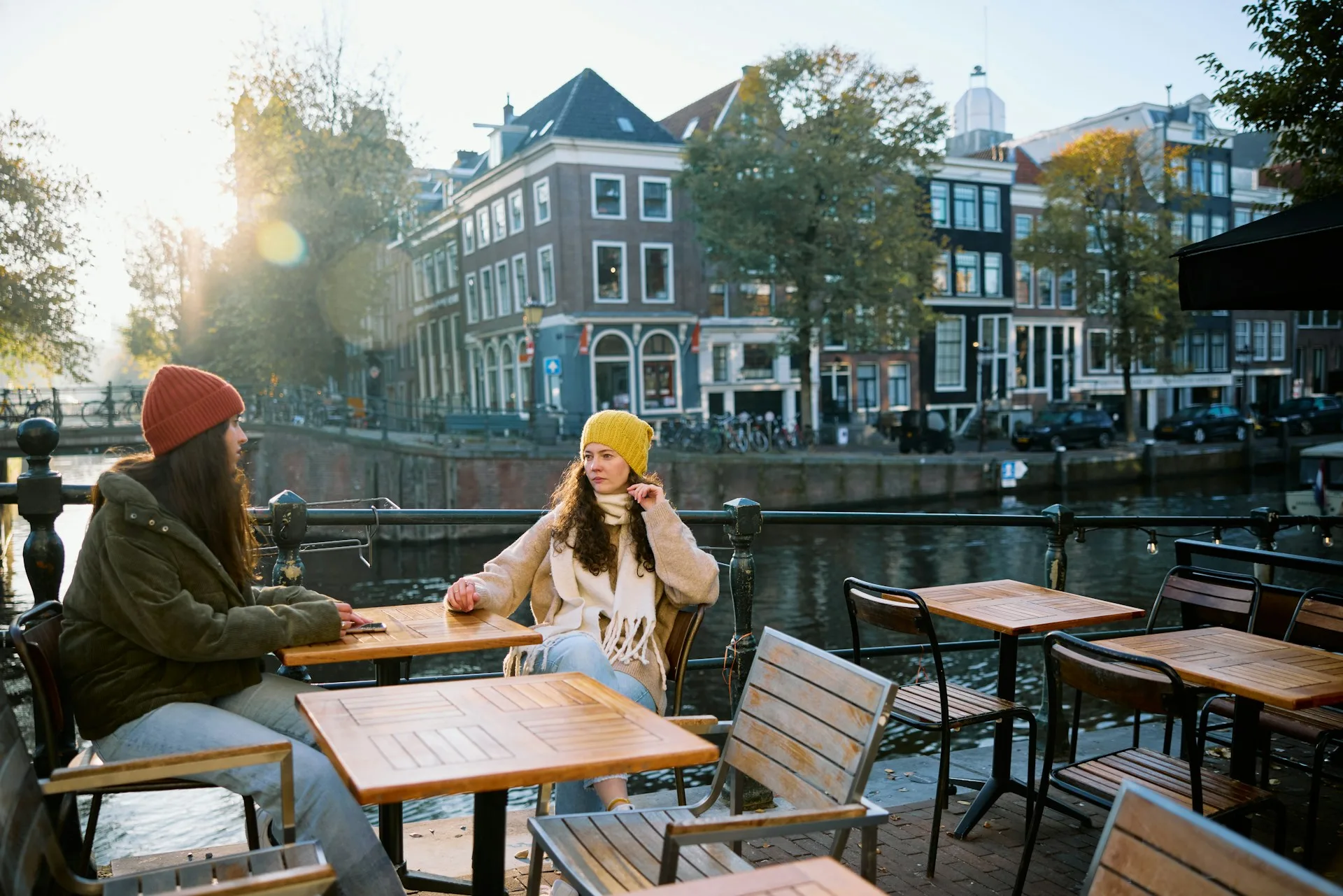
Amsterdam has around 934,000 residents and, depending on who’s counting, somewhere close to 180 nationalities living among them. A solid chunk of those people arrived thinking they were moving to a liberal, English-speaking European city where life would be easy. They were half right. The city is genuinely liberal and almost everyone speaks excellent English. The other half of the equation is that the Dutch will tell you, without a moment’s hesitation, exactly what they think of you, your work, your outfit, and your life choices. If you grew up British, this is going to take some adjustment.
The directness is real, and it’s not rudeness
The Dutch don’t soften feedback. Your boss will tell you directly if your work is substandard. Your neighbour will inform you that your music is too loud without softening the message. A Dutch friend will tell you that outfit does not suit you. For a British person who has spent a lifetime decoding “that’s quite interesting” as “that’s terrible” and “not bad” as “actually very good”, this lands like cold water in the face. The first few times, you’ll genuinely think someone is being rude. They’re not. The Dutch simply prioritise clarity over politeness.
The workplace version of this is particularly jarring. It’s common for a junior employee to openly disagree with a senior manager in a meeting, and this isn’t seen as disrespectful but as a valuable contribution. Brits who’ve spent years carefully phrasing dissent as a mild suggestion will find themselves either mute in meetings or, eventually, liberated by the whole thing. Once you understand it’s not personal, it becomes incredibly efficient and refreshing. Most people get there. It just takes a few months of feeling vaguely insulted.
Planning your own social life
Locals tend to have their weeks planned well in advance, and making plans last-minute is often not possible. Expect to plan meticulously all of your appointments, including hangouts with friends. For Brits who operate on a “fancy a pint later?” basis, this is a genuine culture shock. You’ll learn to book your friends two weeks out like a dentist appointment. Making deep friendships with Dutch people requires patience and persistent initiative. The Dutch are not unfriendly, they’re just not going to adopt you immediately. The Dutch can be reserved, so building friendships might take time. Unlike in some cultures, greeting strangers with a hug and a BBQ invitation isn’t the norm here.
There’s also the money thing. Dutch people can be quite cautious with money, and offering to pay for your friends is not a thing. It’s not uncommon to receive a Tikkie to pay back small expenses, like a coffee you shared with a friend. Tikkie is the payment request app that Dutch people use to split bills down to the cent. You will get a Tikkie for €1.80. You will find this baffling and then completely normal within six months.
The English bubble trap
Here is the paradox of moving to the Netherlands: nearly everyone speaks excellent English, which makes daily life easy but learning Dutch surprisingly hard. The moment you attempt Dutch in a shop or restaurant, most Dutch people will immediately switch to English, partly out of helpfulness, partly out of impatience, and partly because they enjoy practising their English. This creates a comfortable English-language bubble that many expats never leave.
Staying in the bubble is tempting and completely understandable, but it has costs. Social circles, workplace culture beyond international companies, community events, and deeper friendships almost always operate in Dutch. Expats who learn Dutch consistently report higher satisfaction and stronger social integration. You don’t need to be fluent. You need enough to signal that you’re trying to be here, not just passing through.
The bits that genuinely work
The directness has an upside that’s easy to miss when you’re still flinching from it: nobody is playing games. You know where you stand. The work-life balance is not a myth; it’s deeply ingrained. Working late is often seen as a sign of poor time management, not dedication. Dutch people keep clear boundaries between their work and personal life, working hard during contracted hours and then switching off when the working day is over. For anyone who has spent years in a London office pretending to look busy at 6pm, this alone is worth the move.
Cycling in the Netherlands is not recreation, it is transportation. There are more bicycles than people in the country, and the cycling infrastructure is the best in the world. Amsterdam is compact enough to cross by bike in 25 minutes. The first time you ride home from the pub at midnight on a dedicated cycle lane, you’ll wonder why you ever lived anywhere else.
The reality check
Amsterdam is facing a housing crisis, and finding a flat is incredibly difficult, often involving sky-high prices and overbidding as common practice for both renting and buying. Expect to pay £1,600 to £2,200 a month for a one-bedroom in a decent neighbourhood. Culture shock affects most expats during months two to six, coinciding with winter’s limited daylight that can trigger seasonal affective disorder. February in Amsterdam, when it’s grey and flat and your social diary is empty because you haven’t figured out the planning-ahead thing yet, is when people seriously consider going home. Push through it. The city gets considerably easier once the weather turns and you’ve built a rhythm.
The Dutch won’t ease you in gently or pretend things are fine when they aren’t. In that sense, moving to Amsterdam is an honest transaction. You get a well-organised, genuinely open-minded city with great infrastructure and a workforce that actually goes home at five. In return, you accept that nobody is going to manage your feelings, and you will be told your idea is bad before you’ve finished explaining it. Most people who stay long enough end up preferring it that way.