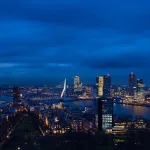

Rotterdam’s south bank has been promising for years and, as of 2026, it’s finally delivering on that promise. The area around Kop van Feijenoord and the emerging De Kaai district is where former Unilever factory land is being transformed into something genuinely worth two days of your life. It’s still a bit rough around the edges, with cranes still looming overhead, but that’s precisely why you should go now.
Day one: from brew to brew
Start where the noise is loudest right now. Kaapse Brouwers has recently opened its new flagship on 16 May 2026 inside the old Calvé peanut butter factory on Nassaukade, at the tip of Feijenoord. The building boasts 50-year-old hex-tile floors, exposed industrial framework, and thirty taps coming straight out of the wall. Founder Tsjomme Zijlstra calls it a dream, which sounds like marketing until you stand in the space and understand what he means.
Grab a stool by the water terrace, order whatever the brewer near you is drinking, and make an afternoon of it. Food comes from chef Sjoerd van den Berg – seasonal, local, designed to sit alongside the house pours rather than compete with them.
From Nassaukade, take the water taxi across the Maas. It costs a few euros, runs regularly, and beats standing on a tram for twenty minutes watching people eat stroopwafels. On the north bank, the M4H district has its own brewery worth knowing: Stadshaven Brouwerij. This is installed in a restored hundred-year-old fruit warehouse in the Merwe-Vierhavens area. It brews close to two million litres a year, making it the second-largest independent craft brewery in the Netherlands, and its 750-square-metre waterside terrace is the kind of place you sit down for one beer and wake up three hours later slightly squinting at the river. Beer runs roughly €5 to €7 a pint across both spots.
The galleries: no white cubes, no admission fees
Rotterdam’s art scene has always been more honest than Amsterdam’s. Witte de Withstraat, a ten-minute tram ride from the south bank, is the densest concentration of contemporary culture in the city. During Rotterdam Art Week in late March, the whole corridor goes late-night, with 60-plus venues running satellite programming alongside the main fair at Ahoy. Outside of that week, the gallery and project-space circuit runs on its own low-key schedule. Check artindexrotterdam.nl before you go: it lists openings, talks, and the kind of events that don’t appear on Instagram until two days after they’ve sold out.
Back on the south side, De Kaai itself is seeding creative space into the development. The site was a closed Unilever compound for over a century; what’s opening now in the repurposed industrial halls has the provisional, slightly-put-together quality of spaces that genuinely don’t know yet what they’ll become. That quality has a short lifespan. The first De Kaai residents are expected to move in by early 2027, at which point the rents go up and so does the self-consciousness.
Night: clubs that know what they’re doing
Rotterdam’s electronic music credentials are not a new discovery. The city has had 24-hour club licences for fifteen designated venues since 2024, and Toffler, in a former pedestrian tunnel under Weena, has a hydraulic DJ booth that physically moves across the floor mid-set. That alone is worth the entry. Clubs open around 23:00; happy hour at the bars runs 17:00 to 19:00, so eat during that window and get oriented before things properly start.
On the south side, the legendary Baroeg is opening a new, larger venue on Spinozaweg in Rotterdam South, with better acoustics and more space. It’s been the city’s underground heavy music anchor for decades, and the new site is its most ambitious version yet. If that’s your register, time your visit accordingly.
The water taxi stops running late, so note the last crossing or budget a few euros for a cab. The BOB night buses cover the city centre once the metro closes; load an OV-chipkaart or just tap your contactless card.
Where to stay and what to budget
The south bank itself has limited hotel stock while construction runs. Accommodation in the city centre or on Katendrecht, a fifteen-minute walk or a short water taxi from De Kaai, runs £70 to £130 a night for something decent. Katendrecht is worth mentioning specifically: the Fenix Food Factory is there, Kaapse Kaap has over twenty taps and a bottle shop, and the Nederlands Fotomuseum opened its new home in the renovated Pakhuis Santos on 7 February 2026. That’s a full morning sorted before you’ve even crossed to the south side. Budget roughly £40 to £60 for a full day of eating and drinking if you’re not going stupid about it. Rotterdam is cheaper than Amsterdam and considerably less annoying about it.