A couple of years ago, Chiang Mai’s Old Town moat was ringed with people holding phones aloft, trying to replicate the exact same shot they’d seen on Instagram. The lantern festivals were gridlocked. Every decent guesthouse in Nimman was fully booked by November. The city felt, briefly, like it was going to collapse under the weight of its own reputation.
That moment has passed, and what’s replaced it is more complicated. According to the Tourism Authority of Thailand, the province set a new record in 2025 with 12 million visitors, including 4 million from overseas. In raw numbers, Chiang Mai is busier than ever. In practice, the crowds feel thinner, the economics are messier, and the city is going through an identity crisis about who it actually wants to attract.
The single biggest shift is the collapse of the Chinese market. Before the pandemic, China was Chiang Mai’s largest international source. Following the Myanmar earthquake in March 2025, arrivals dropped 50 to 60 percent, and the province now receives just eight direct flights per day from China against a pre-pandemic average of 15 to 18. The infrastructure built around high-volume group tours is still absorbing that hit. Elephant parks have been particularly hard to restructure: Maetaeng’s herd has declined from 100 to 70 and staff from 500 to 350, and hot springs complexes across the province report similar contractions.
Who’s filling the gap? South Korea, Japan, and a resurgence of long-haul tourists, with the UK now appearing in the top five for specific attractions. The visitor profile has shifted toward independent travellers rather than package groups. For anyone who’s experienced Chiang Mai under the old tour-bus regime, this is largely good news. For operators who built their business around coach-loads, it’s a restructuring problem.
The infrastructure, meanwhile, has not kept pace with any version of demand. Chiang Mai International Airport operated at 102 percent of its designed capacity during the first quarter of 2025, handling 8.2 million annual passengers against a design limit of 8 million. An expanded terminal is under construction with a target of 16.5 million passengers by 2030, but the short-term reality is that slots are maxed out and new international routes cannot be added. I flew into Chiang Mai last February on a Bangkok Air connection and the approach stack over the city held us for twenty minutes. That is not a one-off.
Then there is the smoke. If you have not heard about the burning season, you need to. It runs roughly from February through April, with the worst concentrated in late February and March, though some years it drags into April. The primary cause is biomass burning from agricultural practices and seasonal forest fires. Chiang Mai sits in a valley, so when there is no wind or rain, all that smoke just sits there. In March 2026, IQAir’s real-time rankings placed Chiang Mai at number one globally, with an AQI of 233, classified as Very Unhealthy for all population groups. The WHO’s safe daily PM2.5 limit is 15 micrograms per cubic metre. On one day in late March, PM2.5 reached 188 micrograms per cubic metre. Do not visit between mid-February and late April without checking air quality daily and packing an N95 mask. This is not a precaution for the anxious. It is basic common sense.
The accommodation market reflects all of this unevenness. During the 2024 to 2025 high season, luxury properties with average daily rates above THB 8,000 ran at occupancies above 85 percent. Midscale and economy hotels managed only 45 to 55 percent occupancy while absorbing rate compression of 15 to 20 percent year-on-year. Over 2,400 registered small hotels and guesthouses compete alongside a shadow inventory of unlicensed short-term rentals. For travellers, this means good deals exist in the mid-range, roughly £35 to £80 a night for something clean and well-located, while the top end remains both expensive and in demand. Budget options are competitive right now, more so than at any point since 2019.
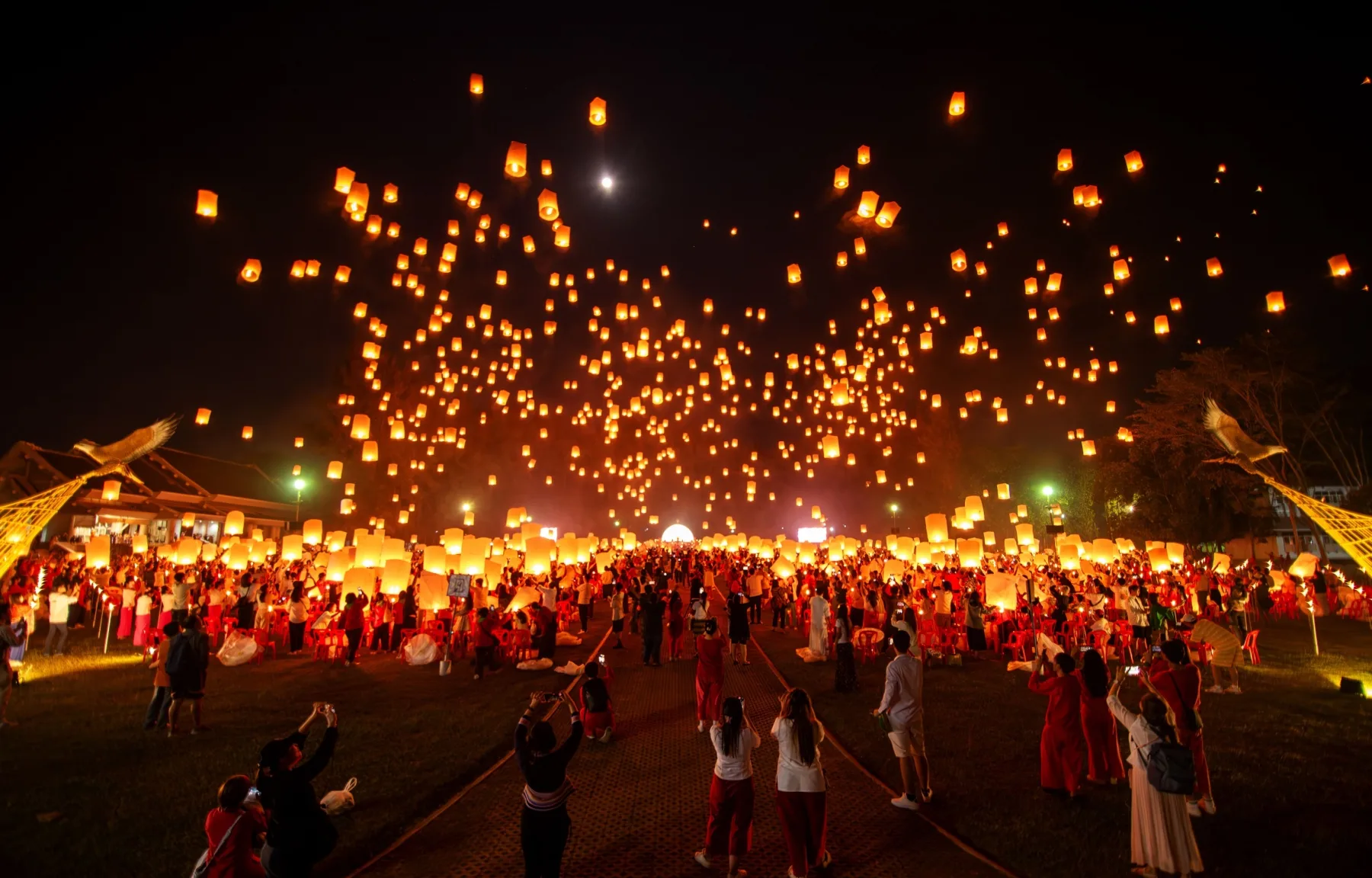
None of that market data explains why people keep coming back. Chiang Mai is one of my favourite places in Thailand, and the reason is simple: it delivers on the things that actually matter. The Yi Peng lantern ceremony in November, when thousands of paper lanterns lift off the banks of the Ping River, is one of the most arresting things I have seen anywhere in Asia. And the Sunday Walking Street market on Ratchadamnoen Road serves street food that outclasses anything I have eaten at a European market, full stop. Khao soi from a cart for 50 baht. Sai ua sausage grilled over charcoal. Mango sticky rice that costs less than a London coffee. The food alone is reason enough to book the flight.

Beyond the city, Doi Inthanon is an easy day trip and a different Thailand entirely. At 2,565 metres it is the country’s highest point, and the cloud forest trails near the summit feel closer to northern Laos than to anything in Bangkok. The twin chedis at the top are worth the early start, and the temperature drop alone is a relief if you have been baking in the lowlands for a week.
The TAT’s official response to all of this is a strategy it calls “Value is the New Volume.” In practice, that means accelerating improvements to the seven temples nominated for UNESCO World Heritage status and trying to extend the tourism season beyond the November-to-February sweet spot with a twelve-festival calendar. Whether any of it works depends partly on factors Thailand cannot control, including smoke drifting in from Myanmar and Laos, which even a complete domestic clean-up would not solve.
Here is the straight answer on Chiang Mai in 2026: go between November and early February, when the air is clean, the weather is cool and dry, and the city is excellent. Avoid March and April unless you are comfortable with hazardous air quality days as a real possibility. The Instagram crush has flattened out, the Chinese group-tour infrastructure is still recalibrating, and the experience is less frantic than it was two or three years ago. The temples, the mountains, the lanterns, the food: all still worth the flight. Just not in March, and not without checking the AQI app first.