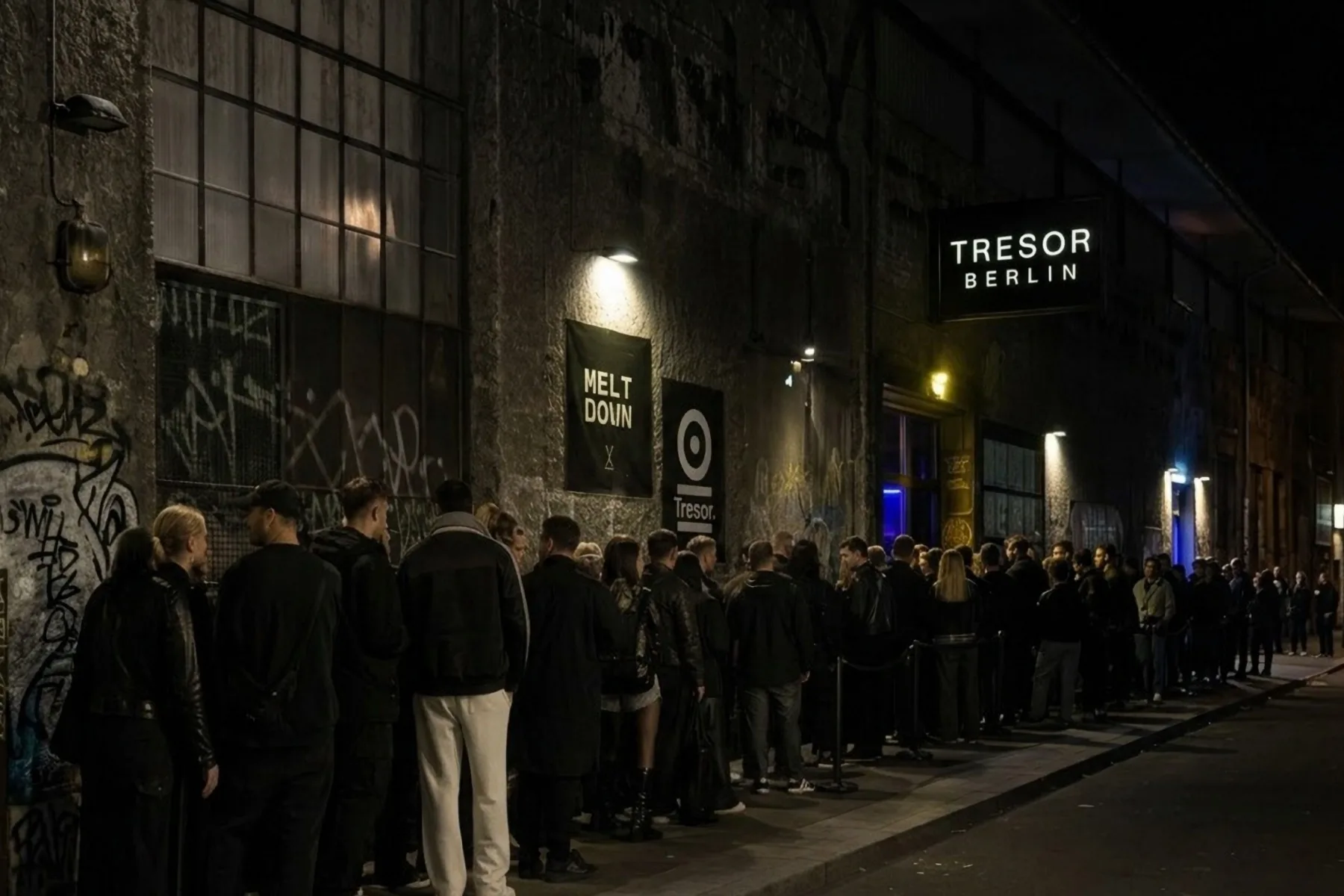
Every city has an unspoken contract at the club door. Ignore it and you will spend the night outside, confused, while someone in a harness and boots walks straight past you. Here is what the locals in three of Europe’s best nights out are actually wearing, and more importantly, why.
Berlin: Black, intentional, and never trying too hard
Berlin’s club scene is split into distinct worlds, and dressing for the wrong one is a quick way to get turned away. At Berghain and Tresor, the dominant aesthetic is deliberately understated: dark clothes, worn boots, nothing that looks like it came off a mannequin that morning. Door staff are not looking at your label. They are clocking whether you look like you belong in a room full of people who have been dancing since Saturday.
The rule of thumb from regulars is simple: dark, comfortable, and functional. Black jeans or trousers, a plain or band T-shirt, solid boots. Nothing pristine. Nothing that says “I dressed up for this”. As one guide for regulars puts it, the aim is to look like you know “the euphoria of feeling locked to the dance floor for hours.” High heels read as a liability, not a look.
KitKat operates on entirely different logic. The dress code there is fetish or extreme: leather, latex, mesh, harnesses, lingerie, or barely anything at all. Nudity is permitted inside. Streetwear gets you turned away at the door without negotiation. The policy applies to everyone, regardless of gender. There is no male exception for a plain T-shirt.
For bars in Kreuzberg or Neukölln, the vibe loosens but does not disappear: wide trousers, thrifted jackets, worn boots. The goal is to look like you actually live here. Sportswear, white trainers, and anything that reads as “night out clothes” in the British sense will mark you immediately.
Amsterdam: Relaxed, but not a tracksuit
Amsterdam is considerably less intimidating than Berlin, and locals will tell you that themselves. The city’s nightlife is “comparable to Berlin in terms of choice, just a little less intimidating,” as the official I amsterdam guide puts it. Most clubs operate on a soft smart-casual baseline: clean dark jeans, a decent top, and footwear that is not from the gym bag.
At the techno end of the spectrum, especially at clubs running longer sets into Sunday, the logic converges with Berlin’s: wear black, skip the heels, do not look overdressed. Locals arriving by bike typically have their outfit in their bag and change on arrival, since most venues have lockers. The Dutch are pragmatic about this in a way that is both charming and deeply sensible.
The smarter clubs around Leidseplein and Rembrandtplein expect a notch up: dark jeans that are not ripped, a good shirt, clean shoes. Stylish trainers pass at the more casual end; obvious sportswear does not pass anywhere. Amsterdam’s fashion sense is described consistently as one of relaxed sophistication, individuality without performance. Turning up in London-standard going-out clothes, sequins and heels, will make you look conspicuously British. One expat who made exactly this mistake summed it up: she came back the next night dressed for a smart lunch at home and felt immediately less conspicuous.
Lisbon: Smart casual, but know your neighbourhood
Lisbon’s approach to nightlife clothing is the most relaxed of the three cities, and the most geographically split. In Bairro Alto, where hundreds of small bars line narrow medieval streets, pretty much anything goes. The bars have no doors to speak of, let alone door policies. The crowd spills onto the street from around midnight. Nobody is assessing your outfit.
Move down to Cais do Sodré and Pink Street, or further to the clubs in Santos and Alcântara, and standards tighten slightly. Smart casual is the clear norm: clean jeans, a decent shirt or top, shoes that are not flip-flops or trainers. Hoodies, shorts, sweatpants, and sports jerseys are specifically flagged as not acceptable at the bigger clubs. At Lux Frágil, Lisbon’s most serious club with river views and a strong electronic programme, expect a door with some actual judgment behind it.
One critical practical point: Lisbon is built on seven hills and much of the city is cobblestone. Heels are a structural mistake as much as a cultural one. Locals wear leather sneakers, loafers, or low-heeled boots, and will quietly clock anyone teetering past them on a gradient at 2am. Nights here start late, clubs do not fill until 1:30 to 2am, and entry runs €10 to €20 typically including one drink.
The one rule that applies everywhere
Across all three cities, the same thing gets people turned away: dressing for a night out rather than dressing for the specific room. The tourist who asks “what should I wear” and puts on their best Saturday-night clothes from home has almost always misread the brief. Look at the club’s social media before you go. Then dress slightly below what you think is required in Berlin, slightly above it in Lisbon, and somewhere in the middle in Amsterdam. That approximation works better than any printed guide.